FutureForge
Overview
A Strategic Design Model for Internal Workforce Transitions in the Fourth Industrial Revolution
FutureForge is a strategic service model that helps UK retail banks move from reactive redeployment to proactive internal mobility by fixing four systemic failure modes: fragmented infrastructure, permission-led culture, low psychological safety, and ad-hoc workforce strategy.
It reframes workforce transition as a continuous journey (not a one-off event), aligning employee agency with strategic workforce planning through an integrated experience architecture, behavioural scaffolding, and governance touchpoints across HR, L&D, SWP, and line management.
Categories
Service Design
Design Strategy
Date
Jul 28, 2025
Client
Royal College of Art
Jump to:
(Click here to view full report)
Key signal:
Empathy‑driven, unified systems that use business objectives, needs, and trends to guide internal mobility and reskilling pathways are associated with higher retention and productivity while also reducing material redundancy and external recruitment costs per role.
Methods:
Multi-level analysis, interviews, system mapping, Multi-state personas + journey mapping, Behavioural modelling, Co-creation, Theory of Change, Service blueprinting.
Validation:
Employee Surveys, Prototype simulation workshop and Co-creation workshops with Financial Services Skills Commission (FSSC) indicate model soundness and signal adoption potential.
Read details below

Research and Discovery
Why retail banking?
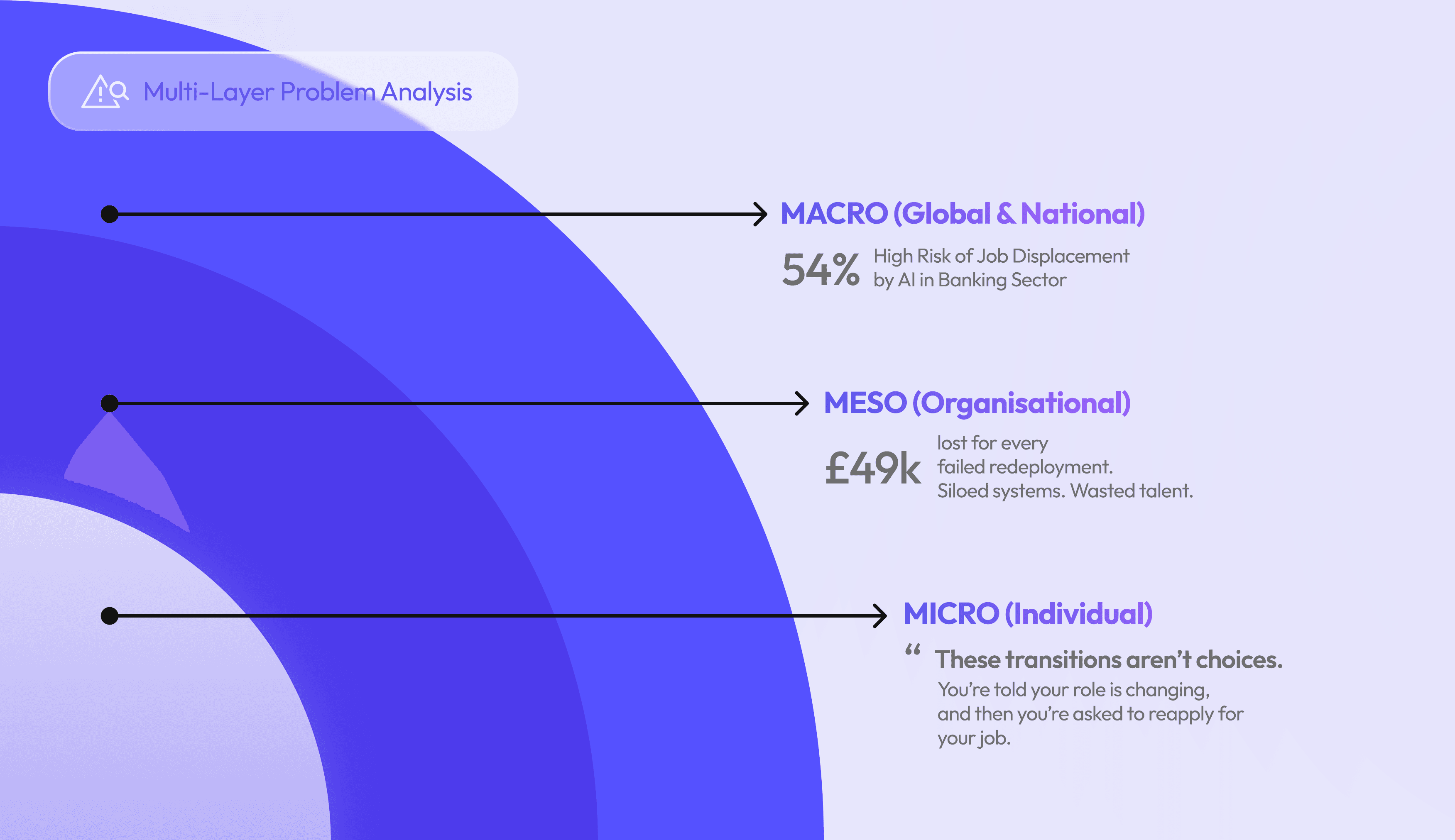
Retail banking faces two primary structural challenges: routine-intensive tasks that are highly susceptible to automation and legacy infrastructure that impedes efficient adaptation. The consequences of role elimination extend beyond financial losses, with each unsuccessful redeployment averaging £49,100. Implementing mobility as an ongoing system, rather than as a standalone human resources initiative, enables banks to minimise unnecessary turnover and retain valuable institutional knowledge that is not easily replicated by competitors.
3 Key Discoveries and pillars for design
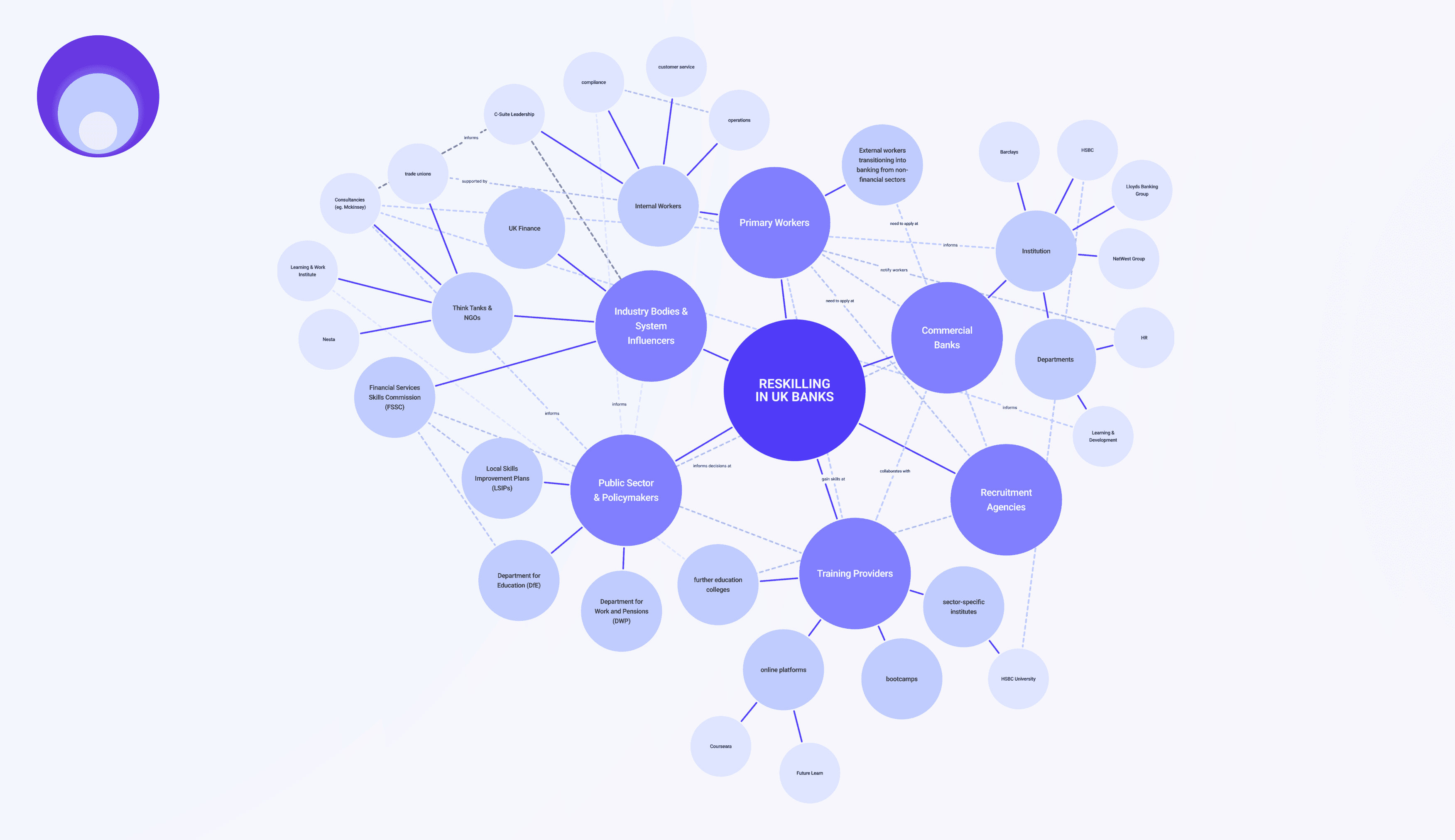
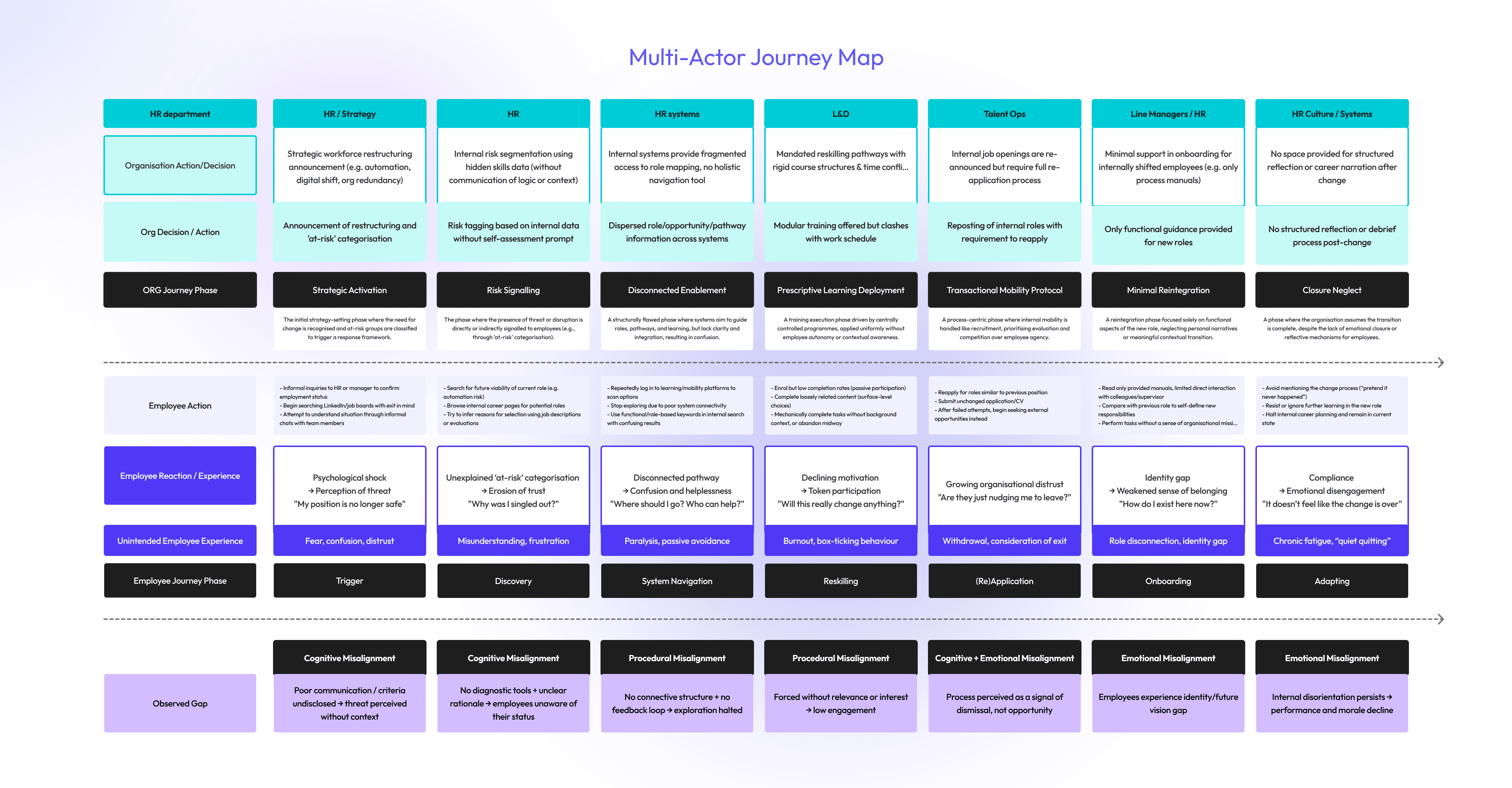
My team's research employed macro-level analysis, stakeholder interviews, system mapping, and journey mapping to investigate the persistent shortcomings of current transition initiatives. Three key findings informed the subsequent analysis and design needs.
Discovery 1
The barrier is navigability, not skills
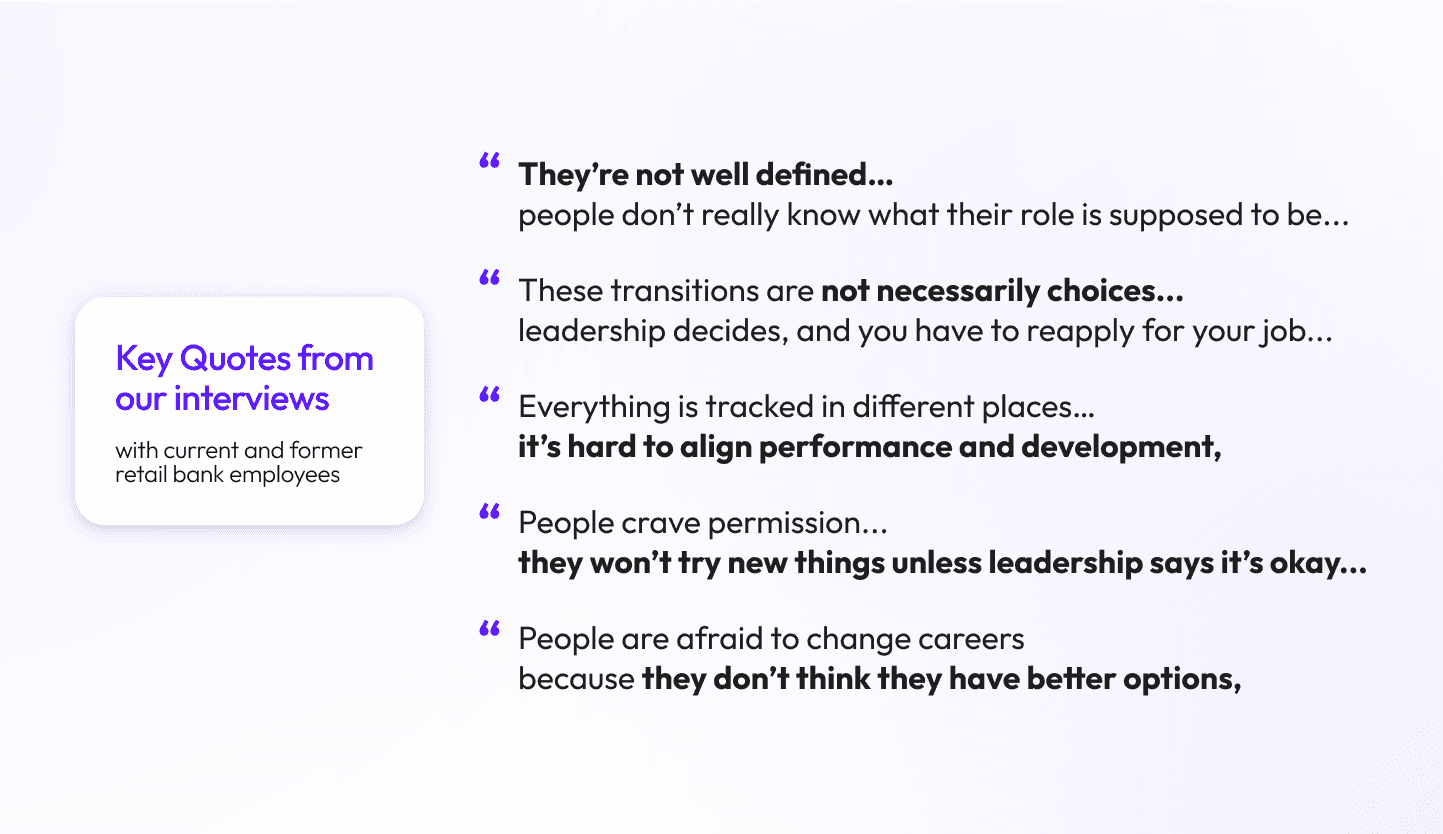
Employees don't lack the potential to move. They lack the conditions that make movement feel safe, visible, and worth attempting. Across our research, transitions were described not as choices but as gambles — opaque role definitions, limited sight lines into realistic opportunities, and access determined more by who you knew than what you could do.
The design implication is precise: a transition system must do three things before it earns the right to offer training content. It must reduce uncertainty by clarifying what's possible. It must reduce social risk by creating environments where exploration doesn't carry professional consequences. And it must lower the effort of navigation through guided, structured progression — not a catalogue of courses, but a system that moves with the employee.
Expand
Discovery 2
Failure is systemic: four breakdowns reinforce each other
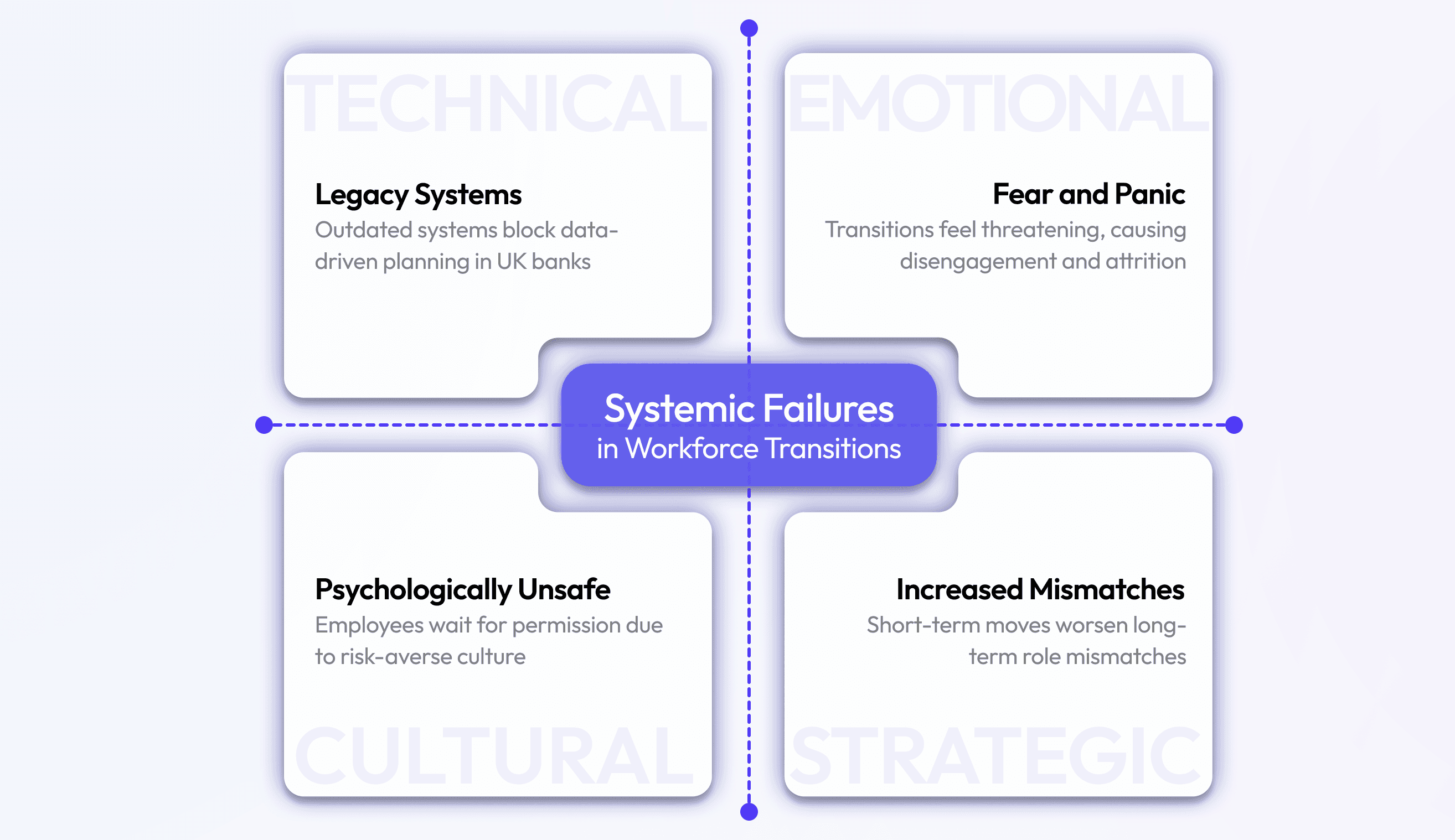
Research converged on four connected failure modes—showing why point solutions don’t stick:
Technical failure: HR, learning, performance, and vacancy data sit in silos, blocking role-readiness visibility.
Cultural failure: permission culture and top-down redeployment suppress proactive exploration.
Emotional failure: fear, fatigue, and low confidence reduce uptake even when options exist.
Strategic failure: ad-hoc initiatives without alignment across HR, L&D, SWP, and business units.
Implication: the intervention must be designed as a coordinated service ecosystem with clear decision rights—rather than a single platform feature set.
These failures explain why existing industry interventions, such as HSBC University, DBS Bank’s internal mobility platform, and Barclays’ career tools, have not resolved the problem. Each targets one dimension. Futureforge should aim to address all four.
Expand
Discovery 3
The solution must change behaviour, not just provide access
Transition behaves like behaviour change: people move from awareness → action → sustained habit. Interventions work best when tailored to readiness.
Testing signals supported three needs:
Guidance without removing agency, or at least it should allude to the feeling of having agency.
• Visual tools that reduce cognitive load, provide information and streamline guidance.
• Feasibility framing that makes action feel near-term and doable (e.g., “two skills away”).
Implication: the design must combine staged behavioural scaffolding with concrete operating mechanics (integration + governance + incentives).
Expand
Design Problem Statement:
Due to limited collaboration between leadership and employees, unclear frameworks for mapping emerging roles and skills, and a lack of employee-centric design in reskilling initiatives, mid-career banking employees are unable to navigate workforce transitions with clarity, confidence, and long-term support.
Developing a new strategic model
What exists, and what must change
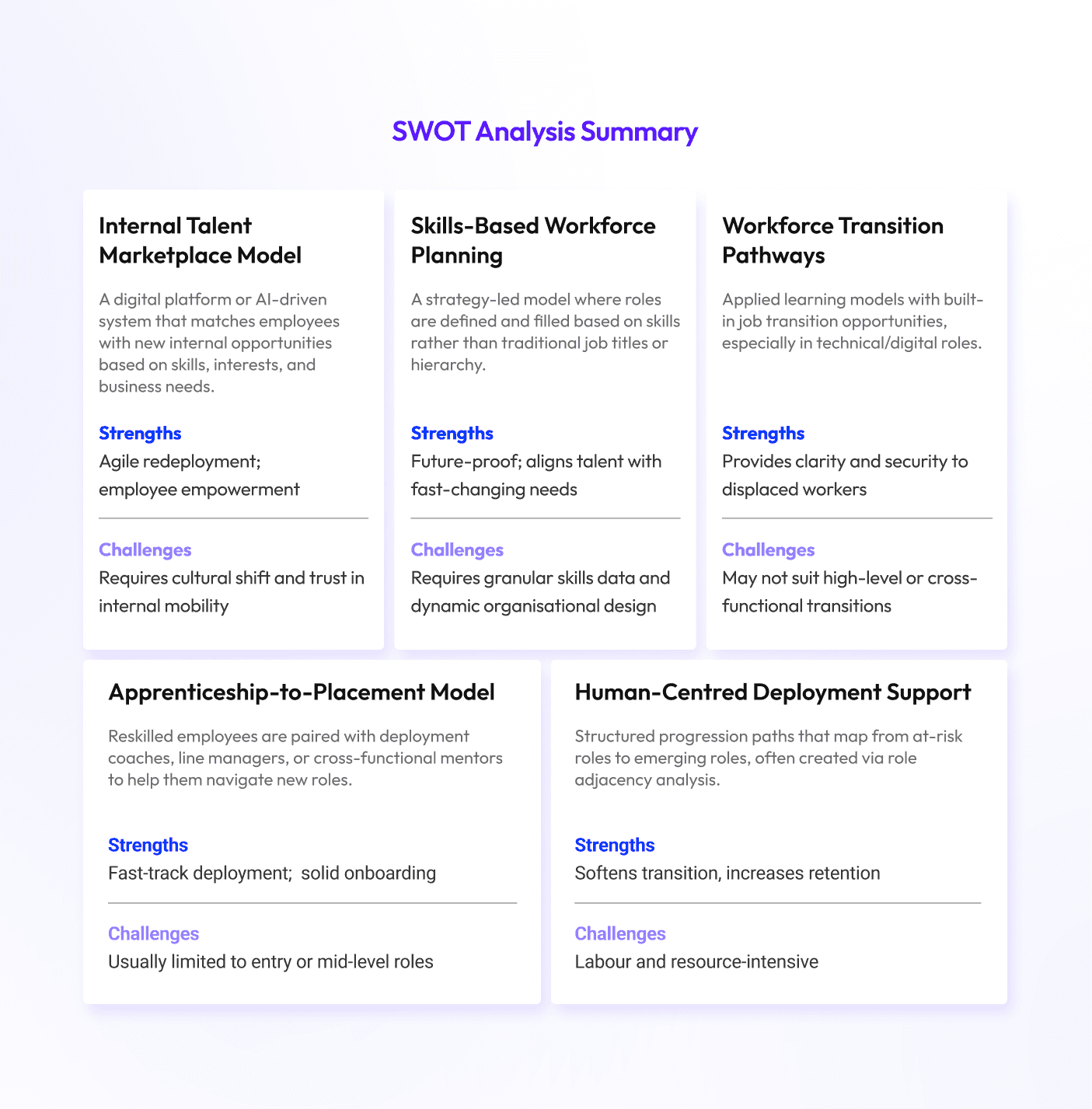
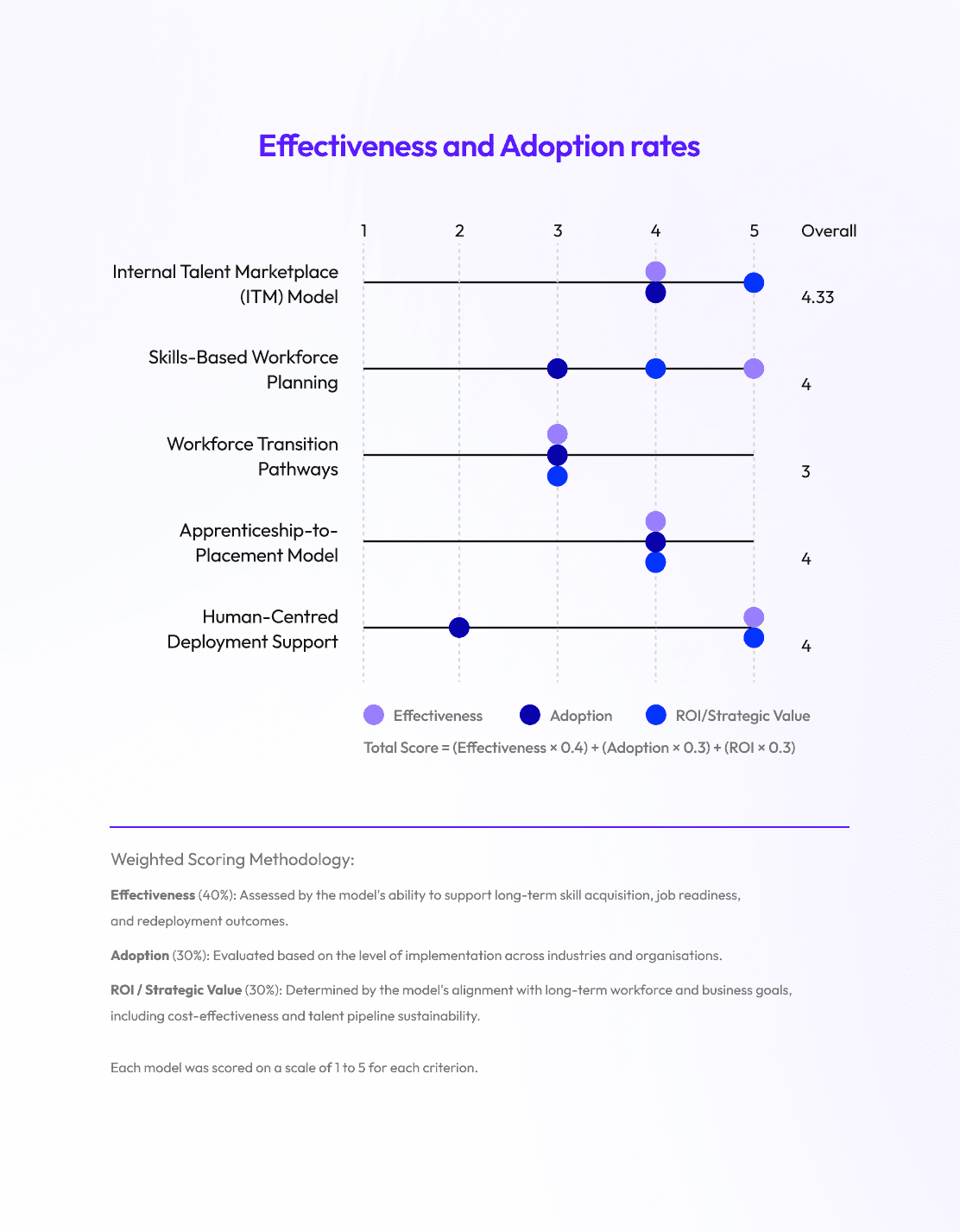
Acknowledging the successes and limitations of existing models, paired with the insights, principles and discoveries made. FutureForge is a strategic model designed to strike a balance between achieving human empathy and embedding it in TMS/HRMS services that help mid-career employees anticipate change, explore realistic pathways, and build role-readiness, while enabling HR/SWP to plan with better skills visibility and internal deployment signals.
The problem is not that banks lack tools for workforce transition.
The problem is that existing tools are positioned after the crisis, rather than before it. Employees receive support only after a disruption has occurred, by which point trust is already broken.
Our multi-actor journey map and system mapping revealed five interconnected feedback loops shaping how transitions succeed or fail: growth and engagement, skill visibility and matching, career clarity, leadership trust, and reskilling and mobility. At the centre of all five sit two structural barriers: cultural and top-down control, and system fragmentation.
How might we help banking professionals navigate workforce transitions while fostering collaboration between employees and leadership, clarifying pathways to emerging roles and skills, and enabling employee-centred reskilling?”
Mechanisms of Change
How and why this works
Designing with behaviour mechanisms ensures users can move
from reactivity to proactivity
Services created with human empathy increase the likelihood of achieving business goals.
Change takes intentional steps
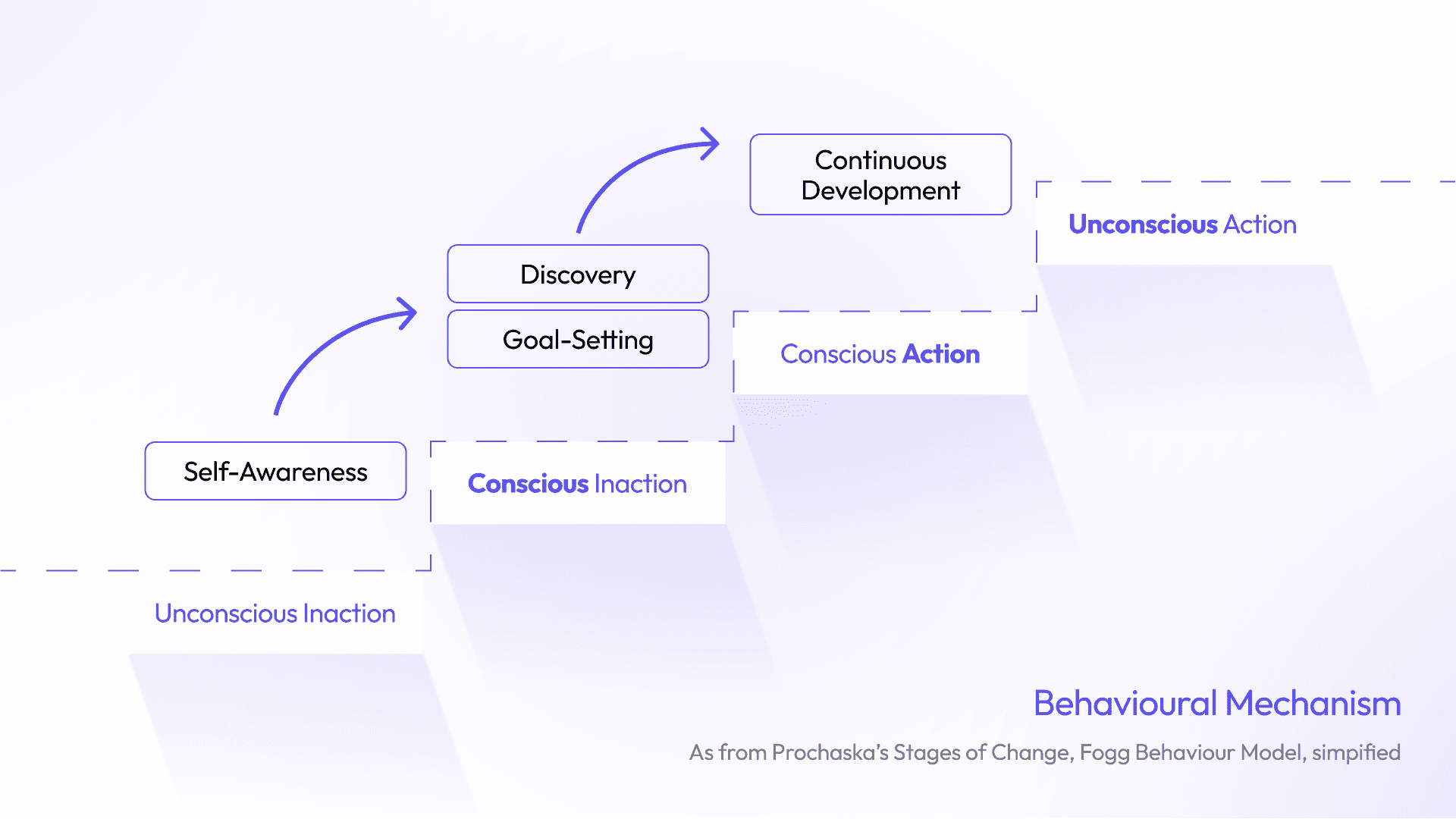
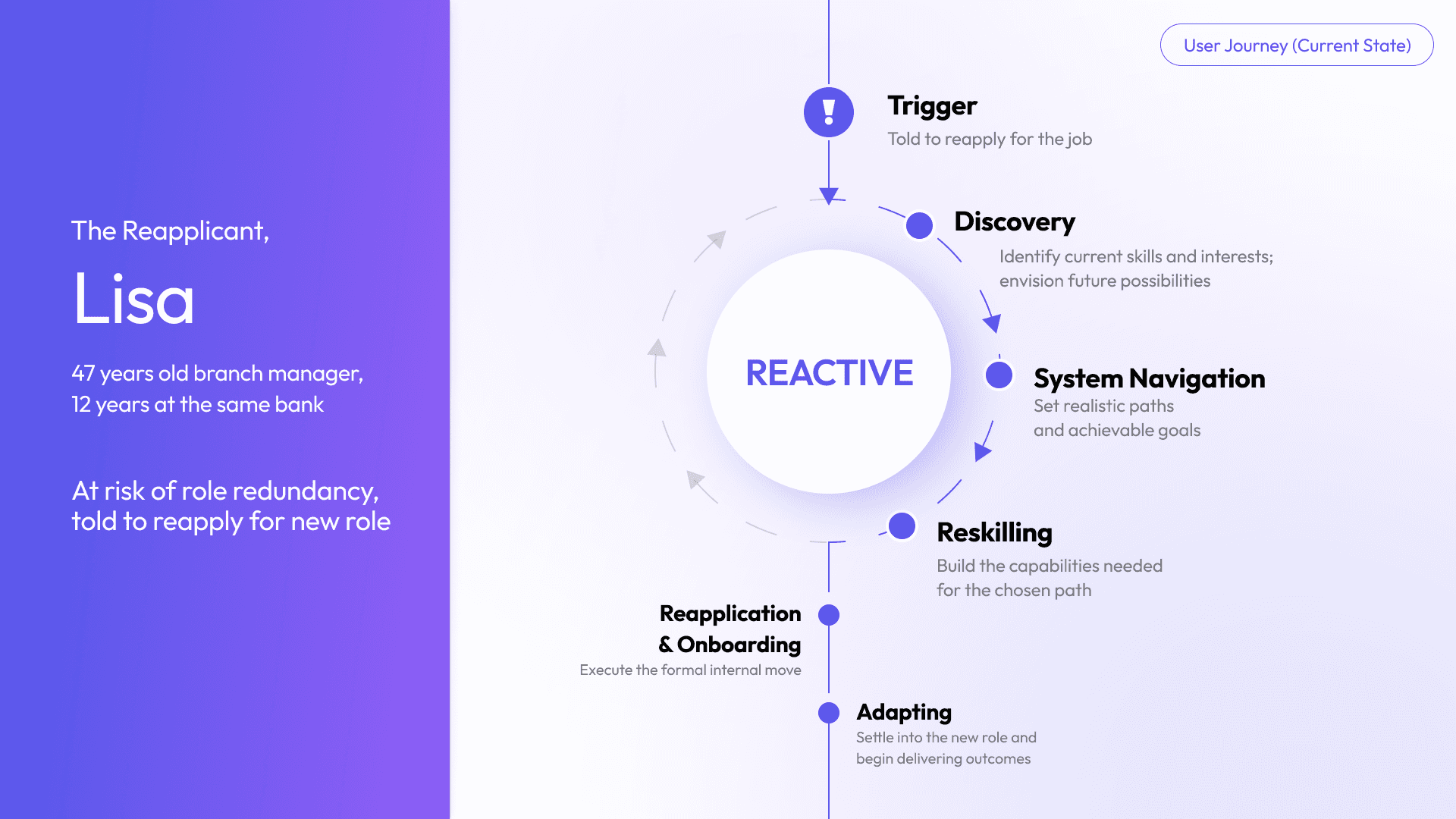
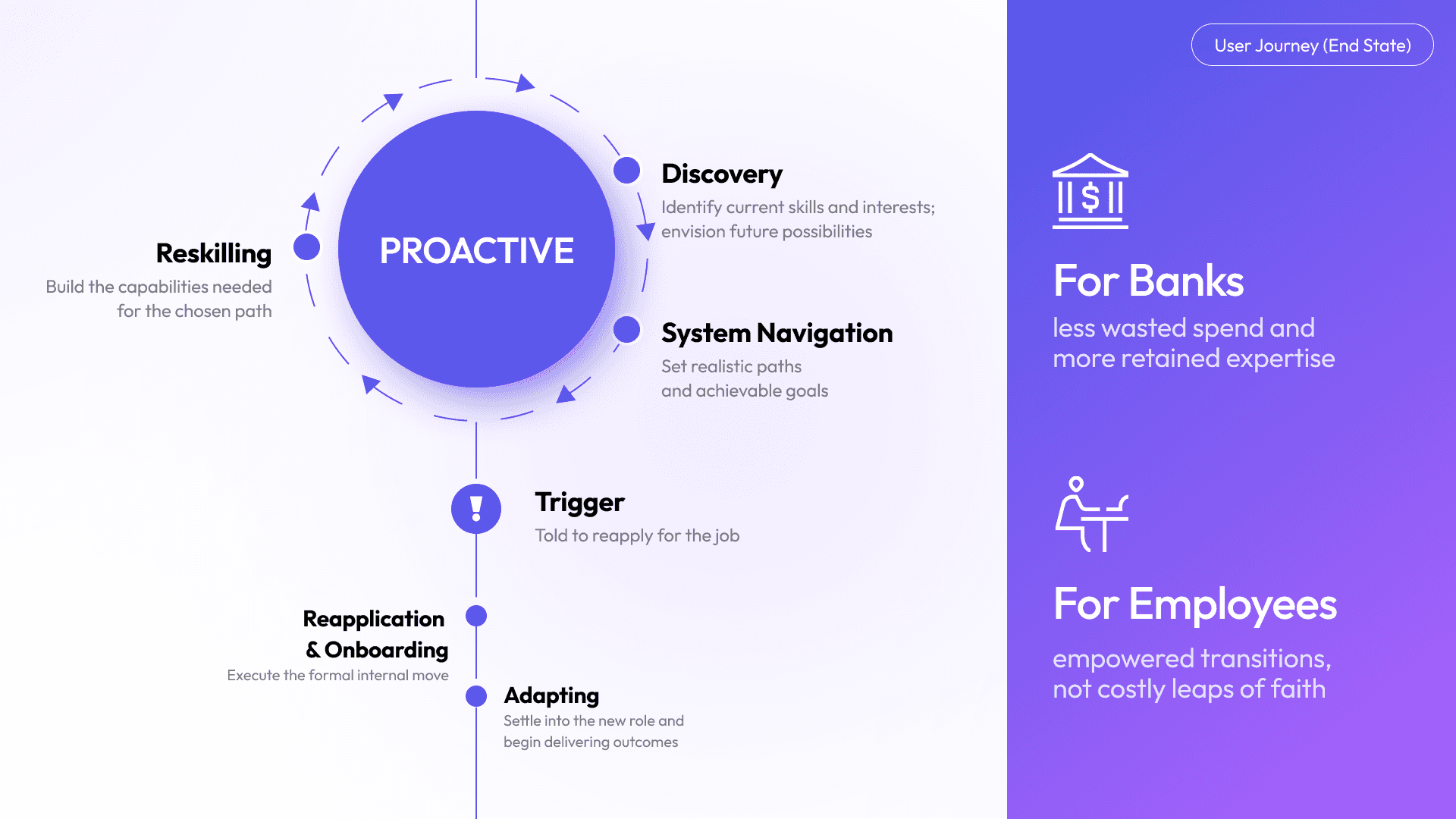
The shift Futureforge proposes is not a feature upgrade. It is a reframing: from transition as an event to transition as a continuous, supported journey. From one-time reskilling to proactive career development. From passive notification to active employee agency.
The most significant design intervention is not what happens during the trigger; it is what happens before it. Employees who have already mapped their skills, explored adjacent roles, and set career goals will be able to respond to disruption with confidence rather than react in panic.
The future of HRMS systems
Designing features needed in Futureforge
The service operates across three behavioural stages, mirroring how people actually navigate change.
Based on Prochaska’s Stages of Change and Fogg’s Behaviour Model, each stage has distinct emotional and cognitive needs. Our platform’s features are calibrated to meet people where they are.
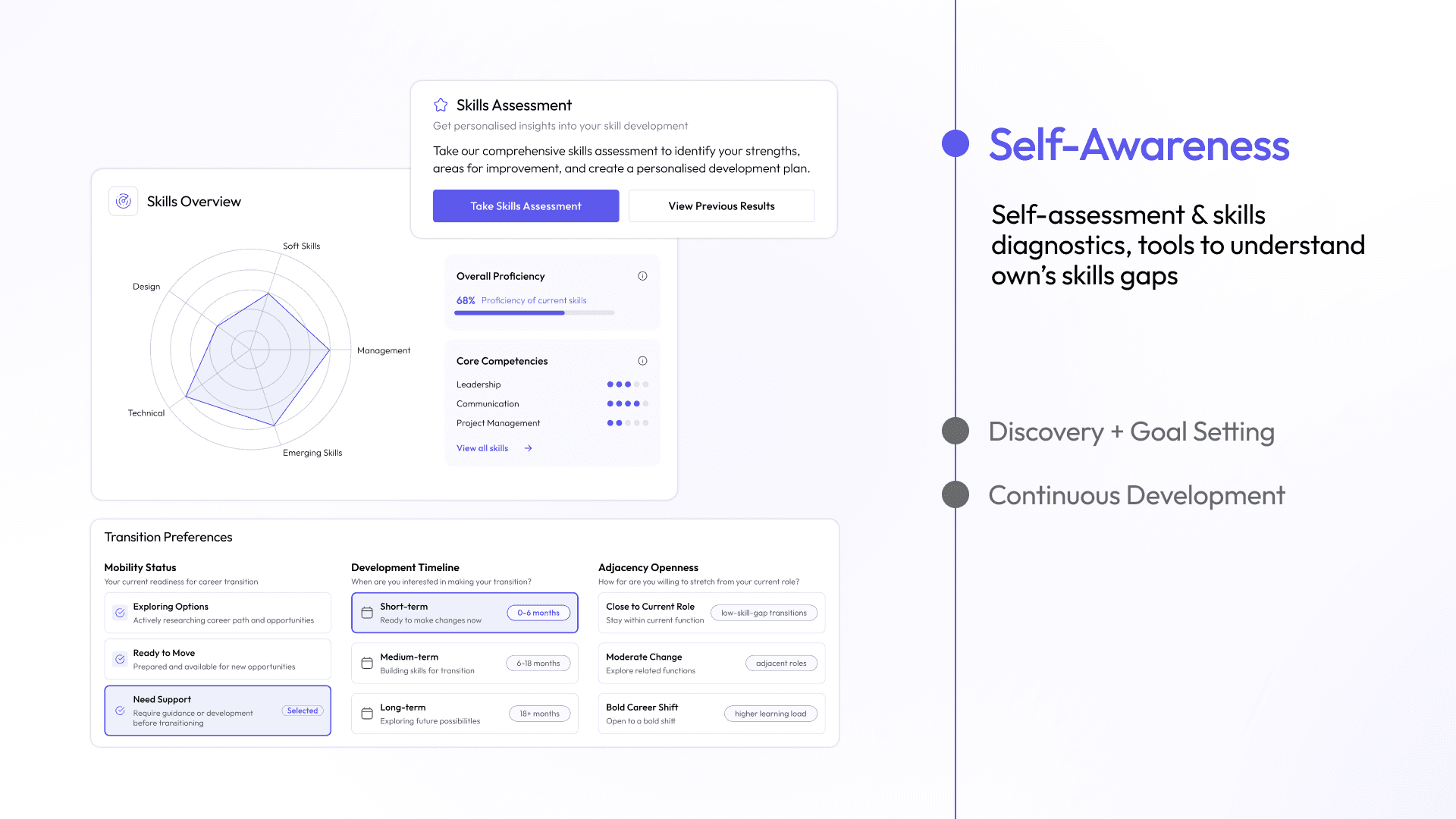
Stage 1
Self-Awareness
Most employees do not know their role is at risk until it is already being restructured. The first design challenge is making invisible risk visible, without triggering panic.
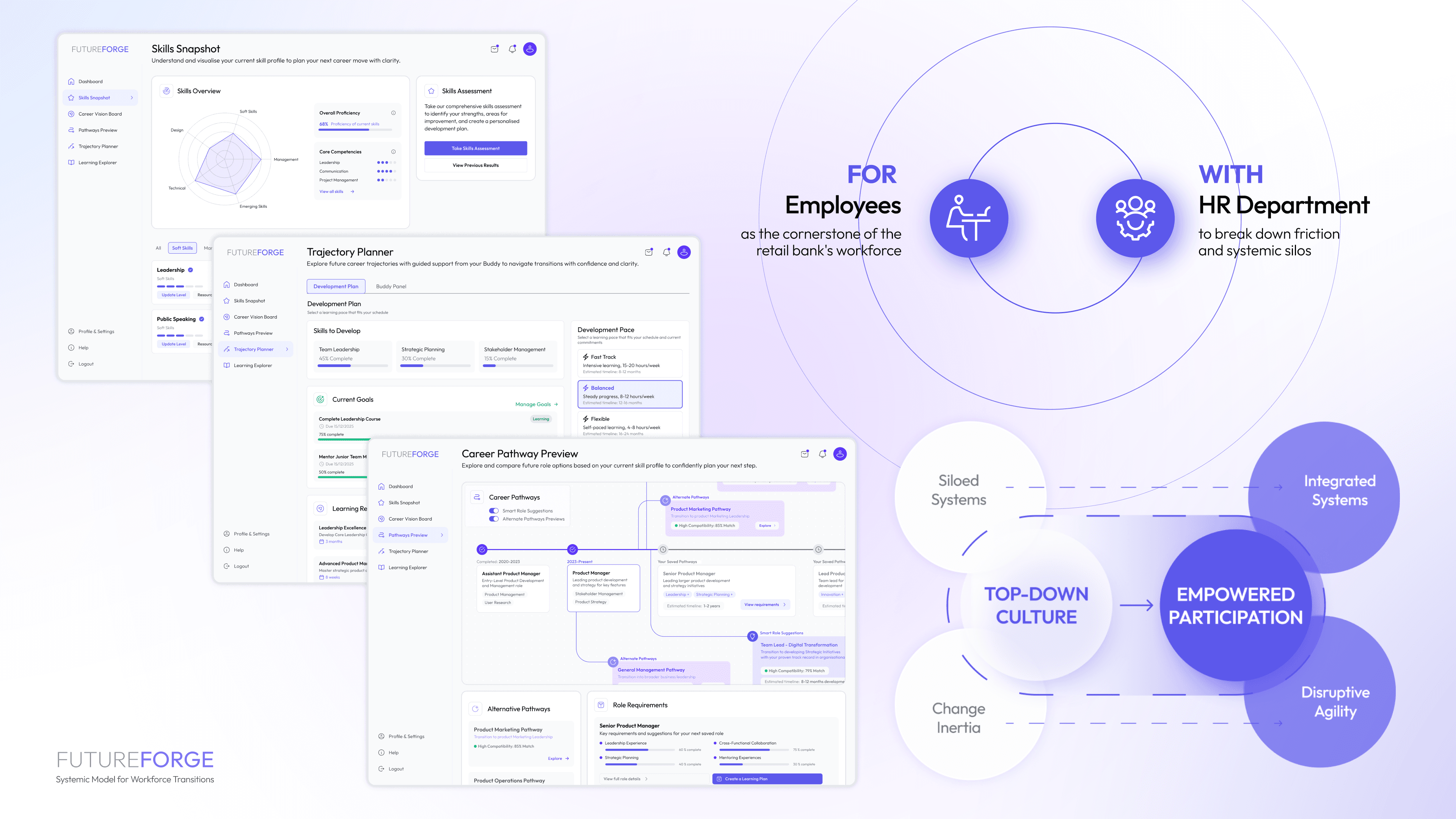
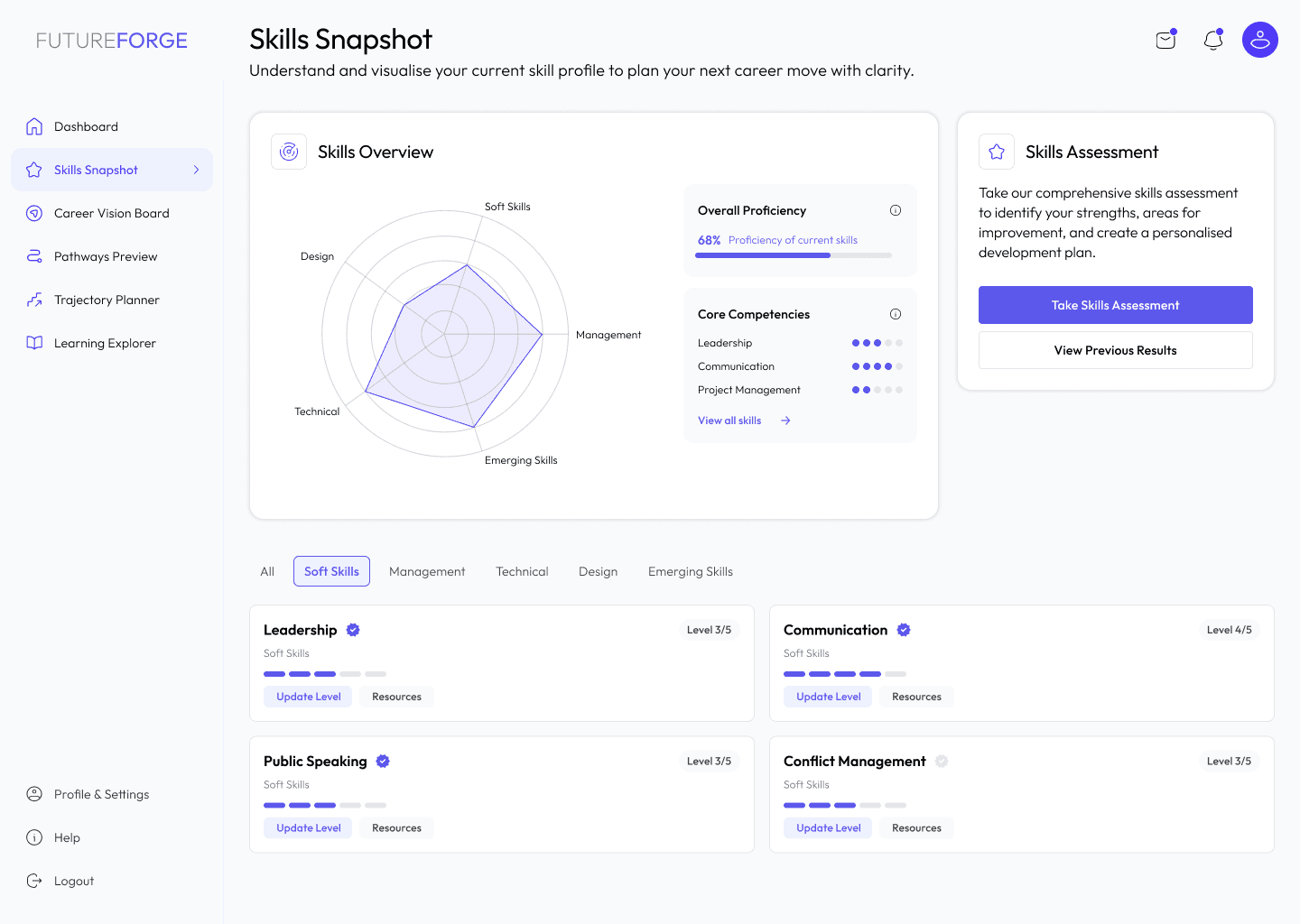
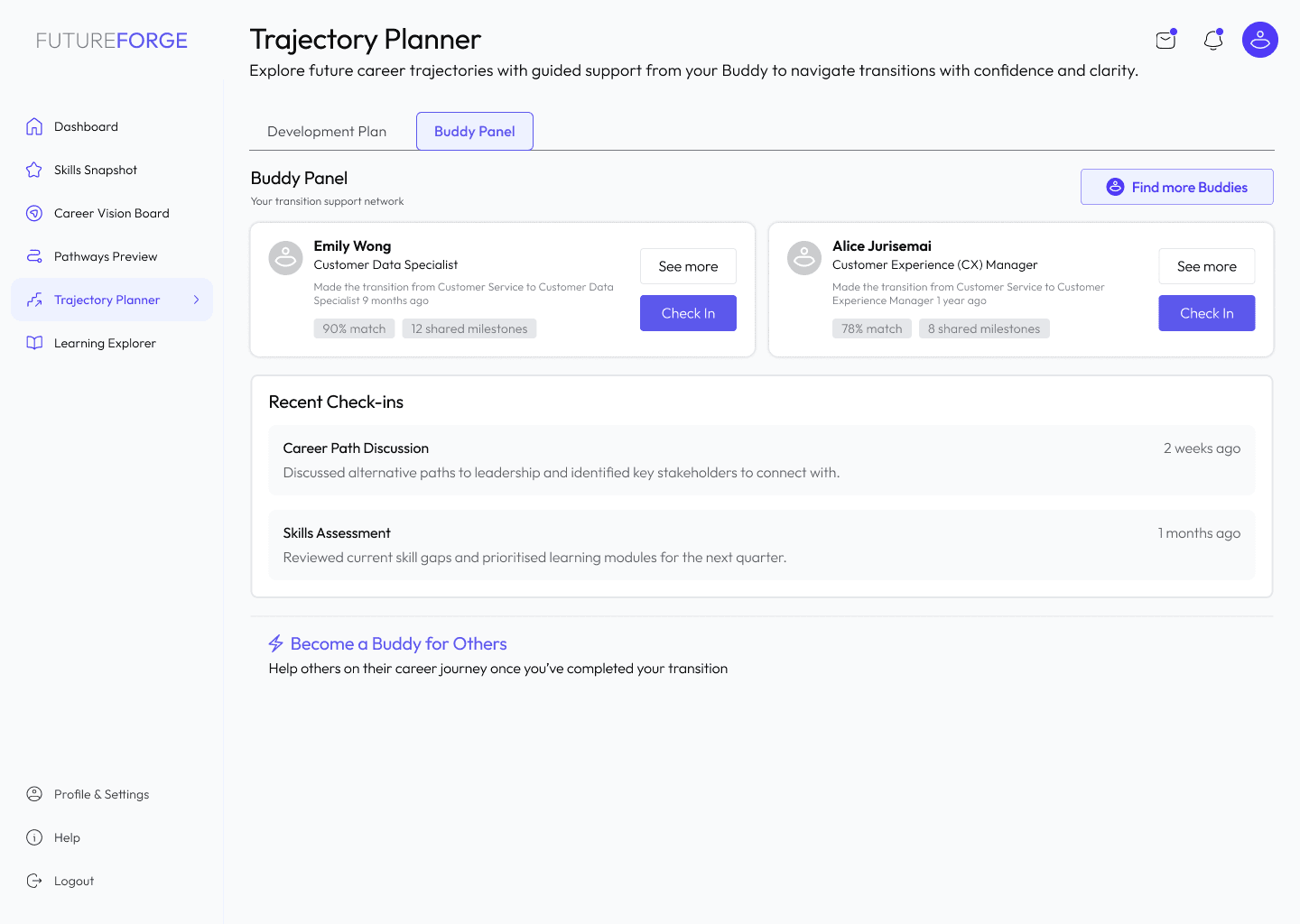
FutureForge’s Skills Snapshot tool draws on performance data, HR records, and live market intelligence to generate a personalised skill profile. Empathetic nudges — framed as opportunities rather than warnings — surface skill obsolescence before it becomes a crisis. An Emergency Mode activates targeted support for employees identified as high-displacement risk, providing immediate action plans and coaching referrals.
Our prototype testing validated a key hypothesis: when transitions are framed as near-term, achievable steps rather than distant threats, employees are significantly more likely to take action. The prompt “you are two skills away from this role” outperformed generic pathway recommendations in every test.
Stage 2
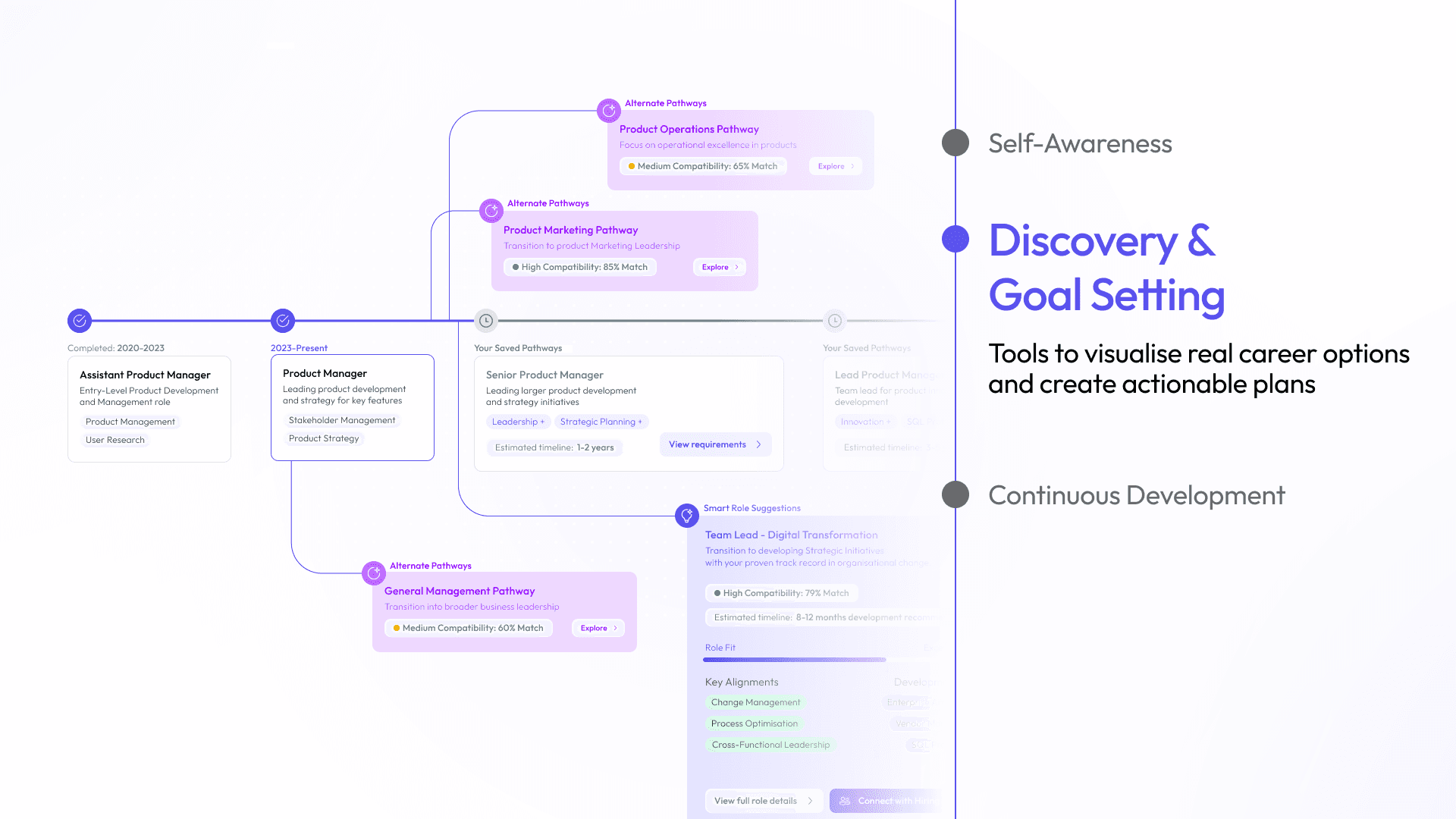
Discovery and Goal Setting
Awareness is not enough. Employees who understand their skill gaps still face a second barrier: they cannot visualise what their future could look like, so they cannot commit to a direction.
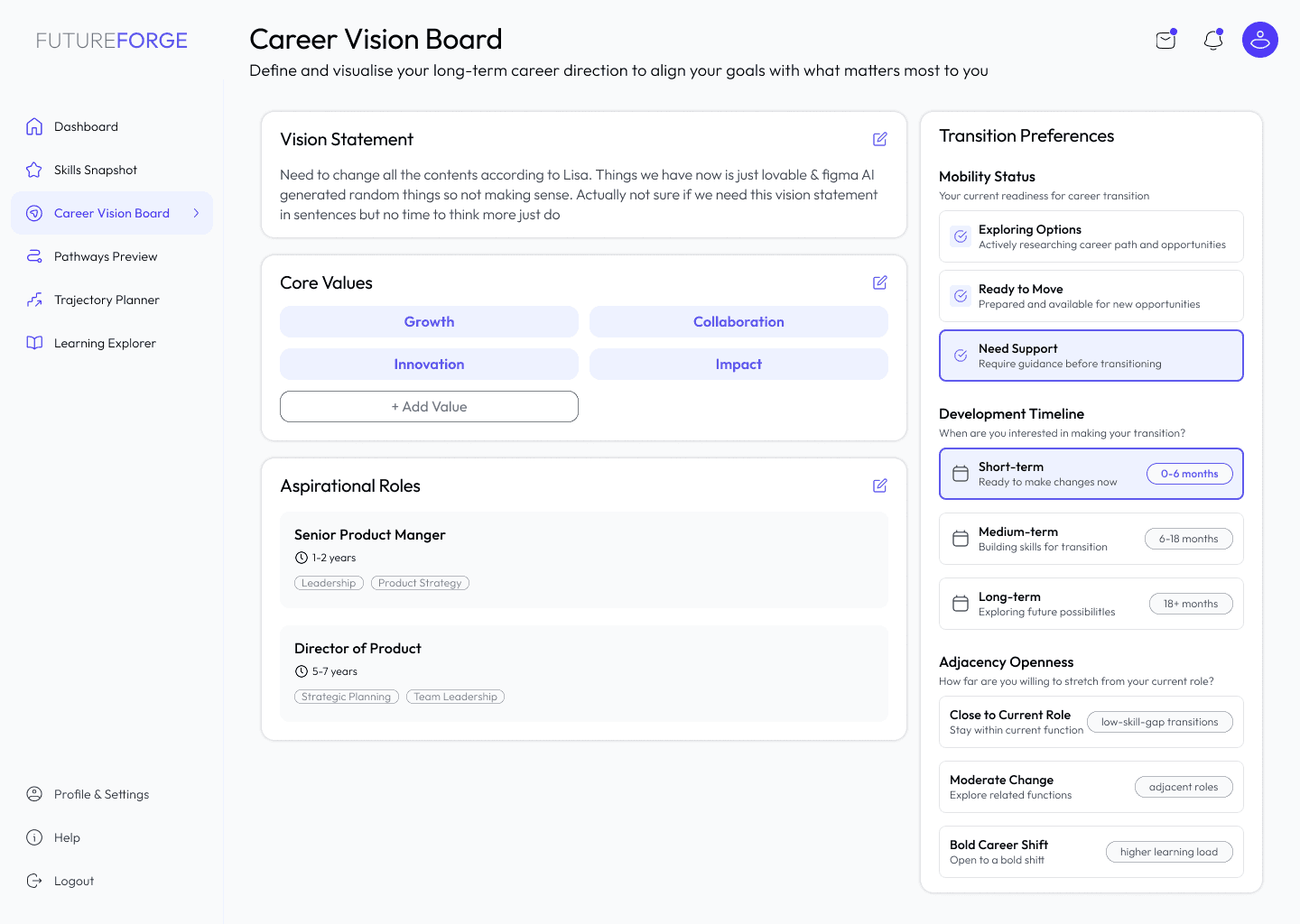
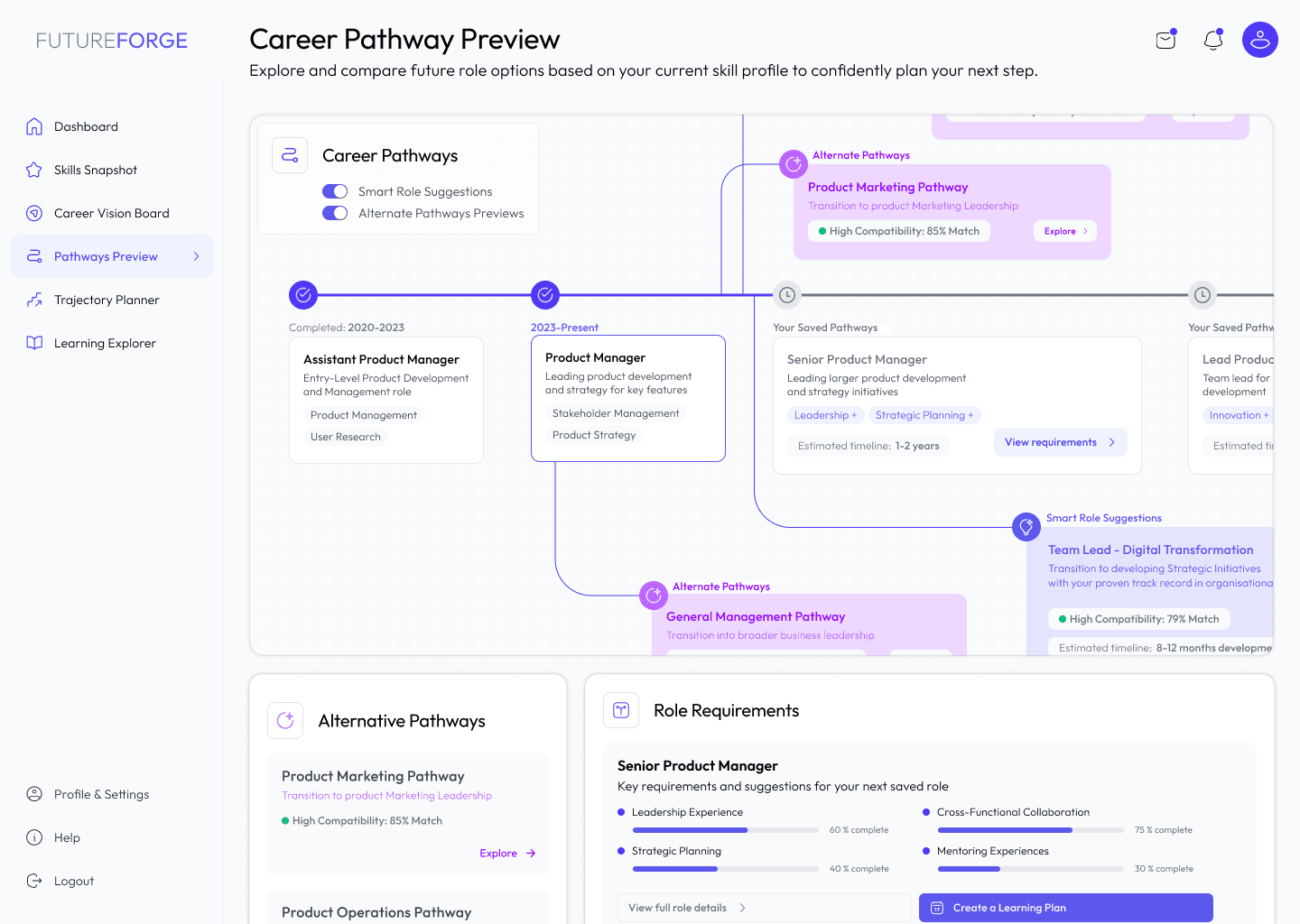
The Career Pathways Visualiser maps realistic transition routes based on each employee’s current profile, adjacent skill clusters, and historical mobility data from comparable colleagues. Comparison Profiles — anonymised stories of employees who made similar moves — make possible futures tangible and relatable. A Live Skills Heatmap shows which capabilities are rising or declining in market demand, grounding personal decisions in external reality.
This combination addresses the most persistent gap identified in our FSSC co-creation workshop: employees want to make proactive decisions but need trusted data and real examples to do so. Vague future-of-work messaging does not change behaviour. Specific, personal, evidence-grounded options do.
Stage 3
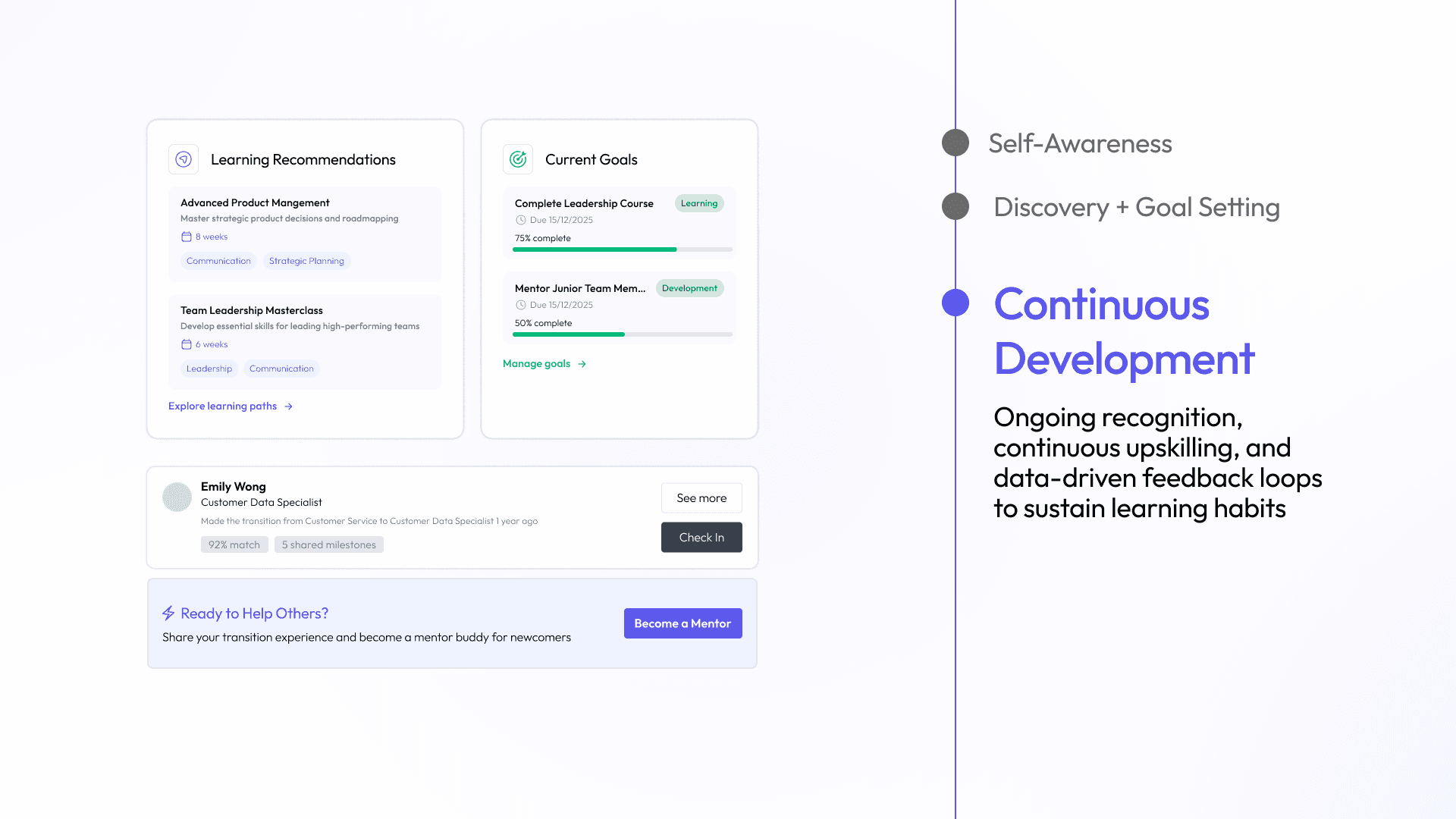
Continuous Development
The most common point of failure in reskilling programmes is not the start — it is the middle. Once initial motivation fades and new behaviours are not yet habitual, employees disengage. Existing tools provide no support at this stage.
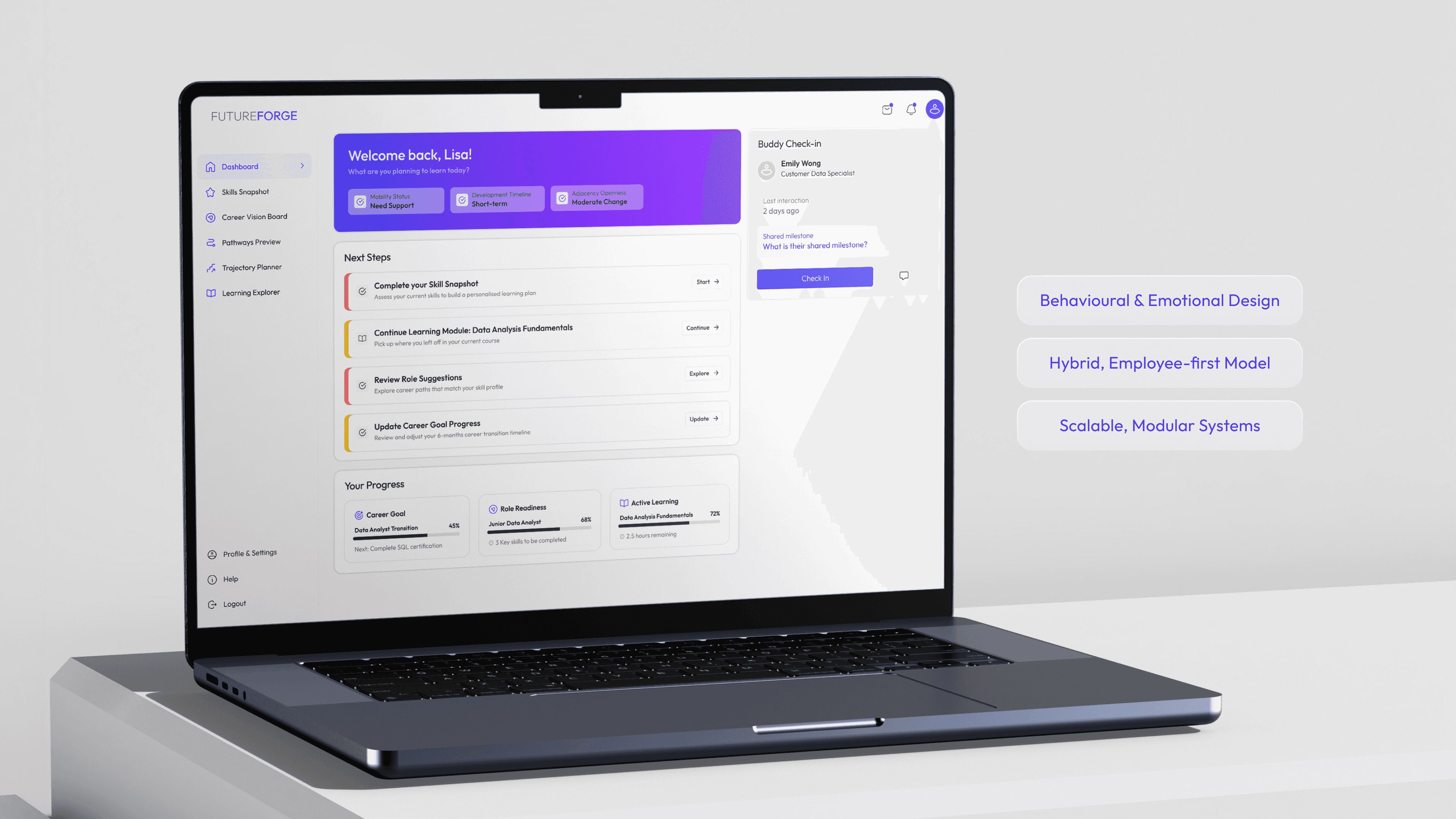
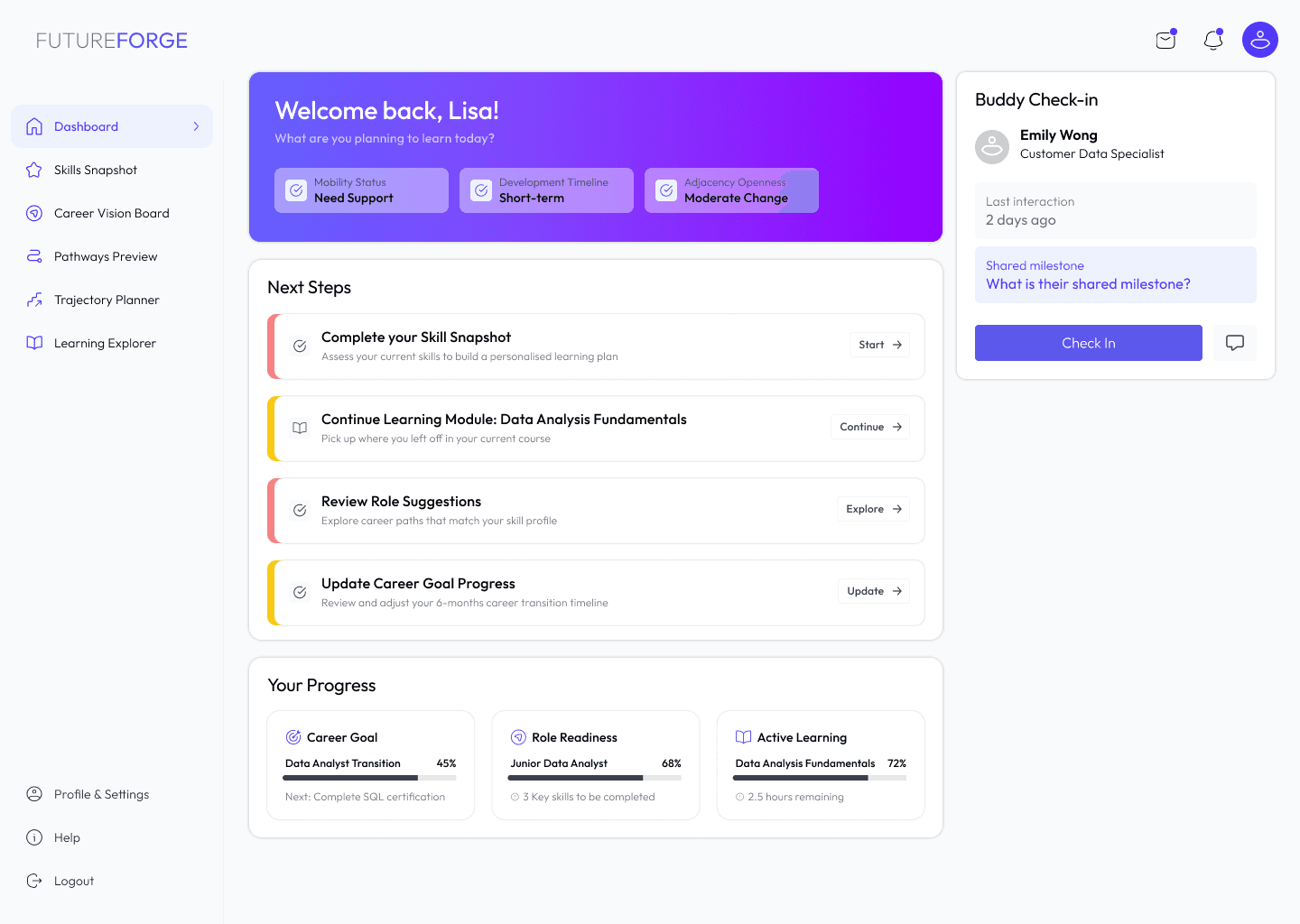
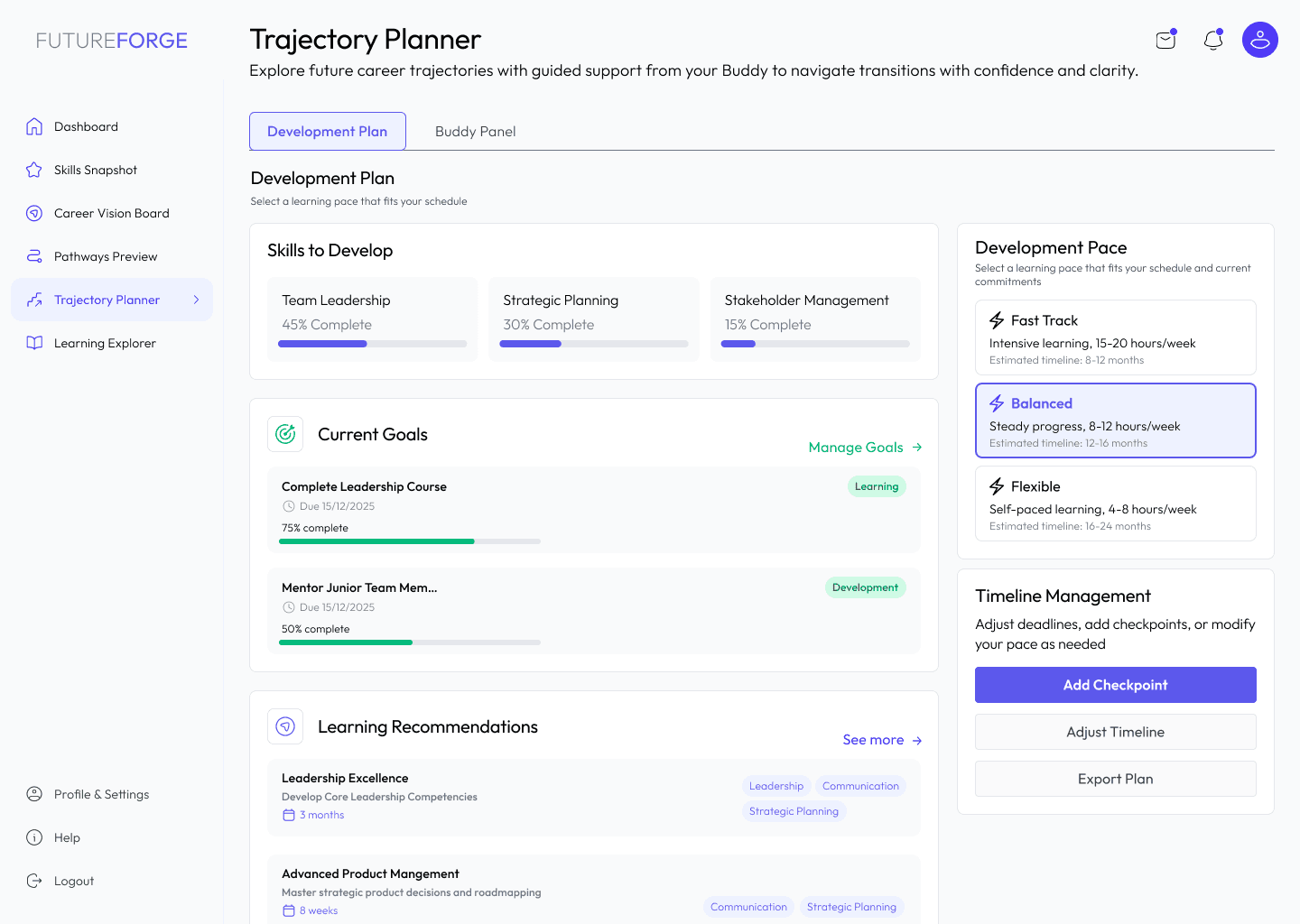
FutureForge addresses this through a Personal Development Dashboard that tracks progress against selected goals, integrates learning recommendations from the internal LMS, and connects employees with peer mentors who have completed comparable transitions. Progress milestones trigger recognition, reinforcing behaviour at the precise moment it is most fragile.
For HR and L&D teams, this stage provides the clearest organisational value: real-time visibility into employee intent, capability gaps by team and department, and automated alignment between individual development plans and Strategic Workforce Planning forecasts.
Validation and Co-design
What was learnt and what changed
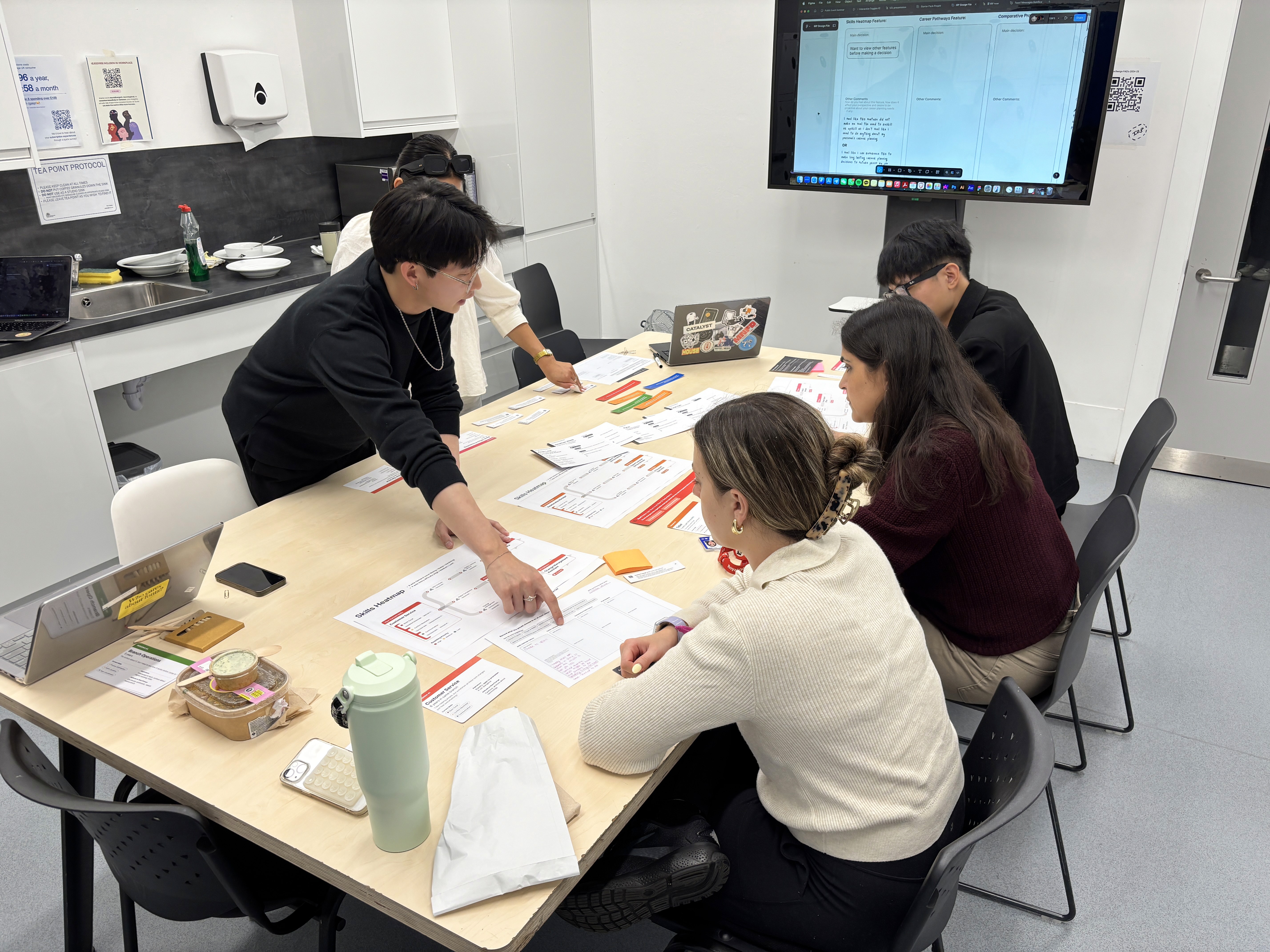
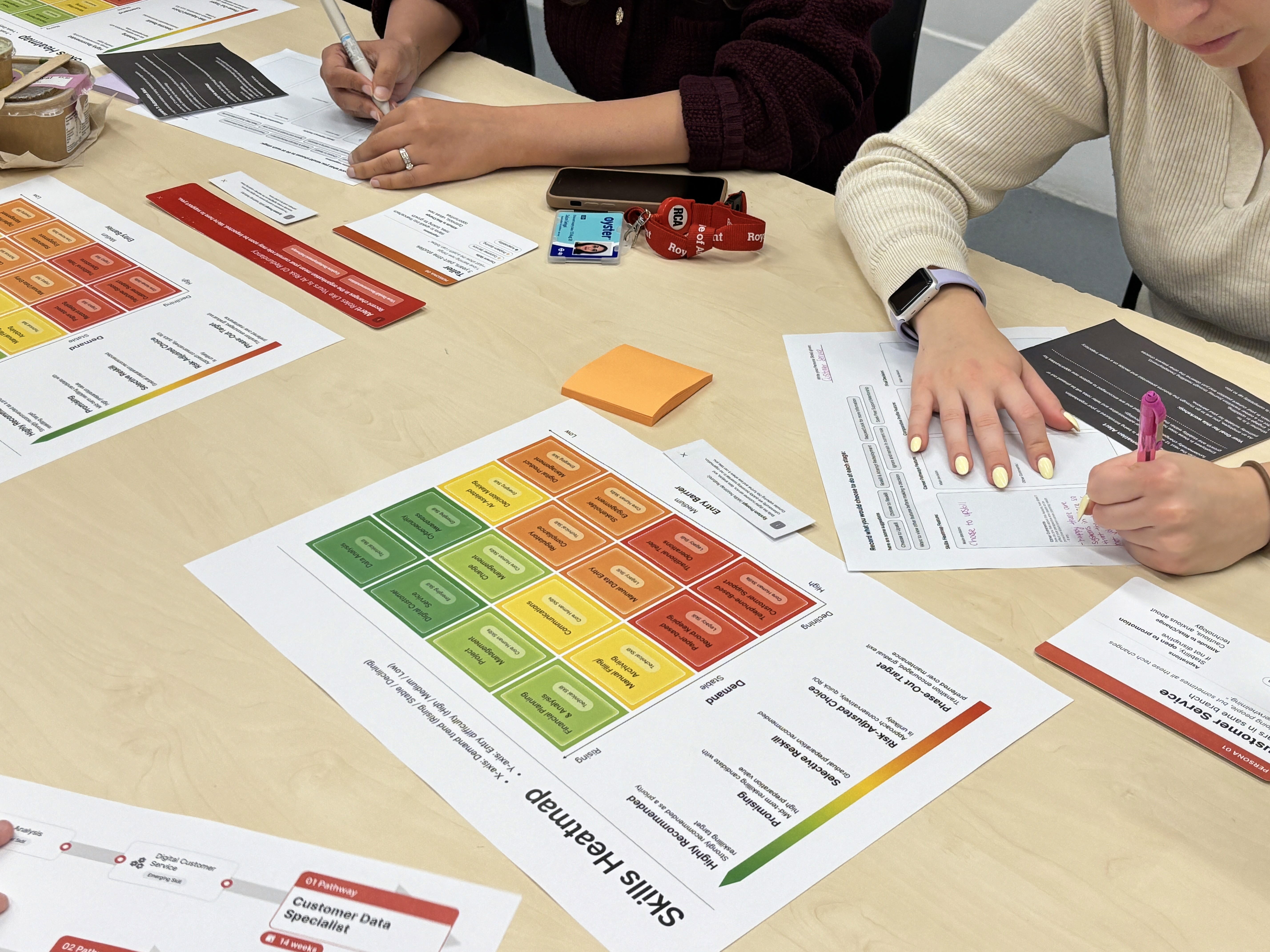
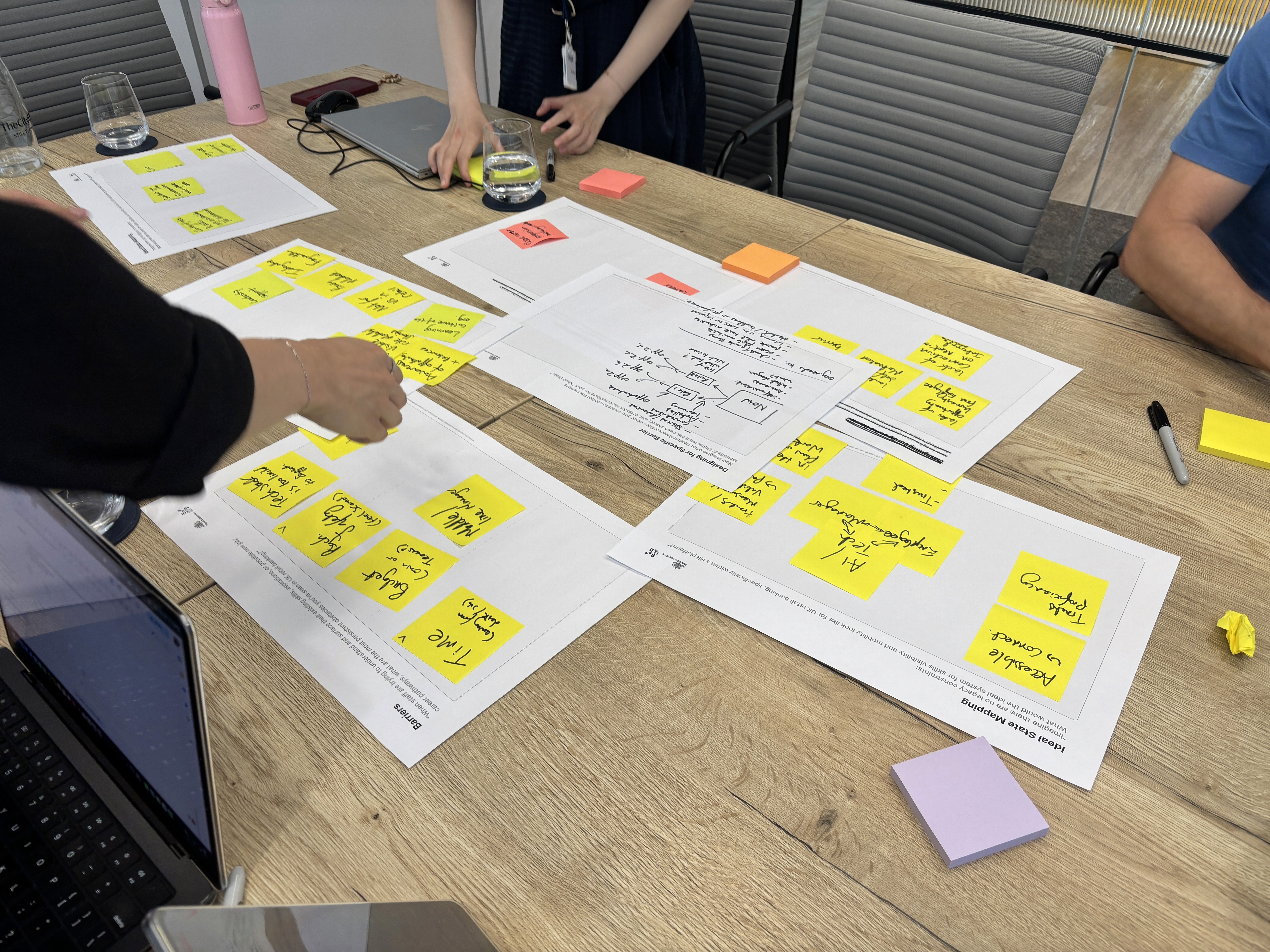
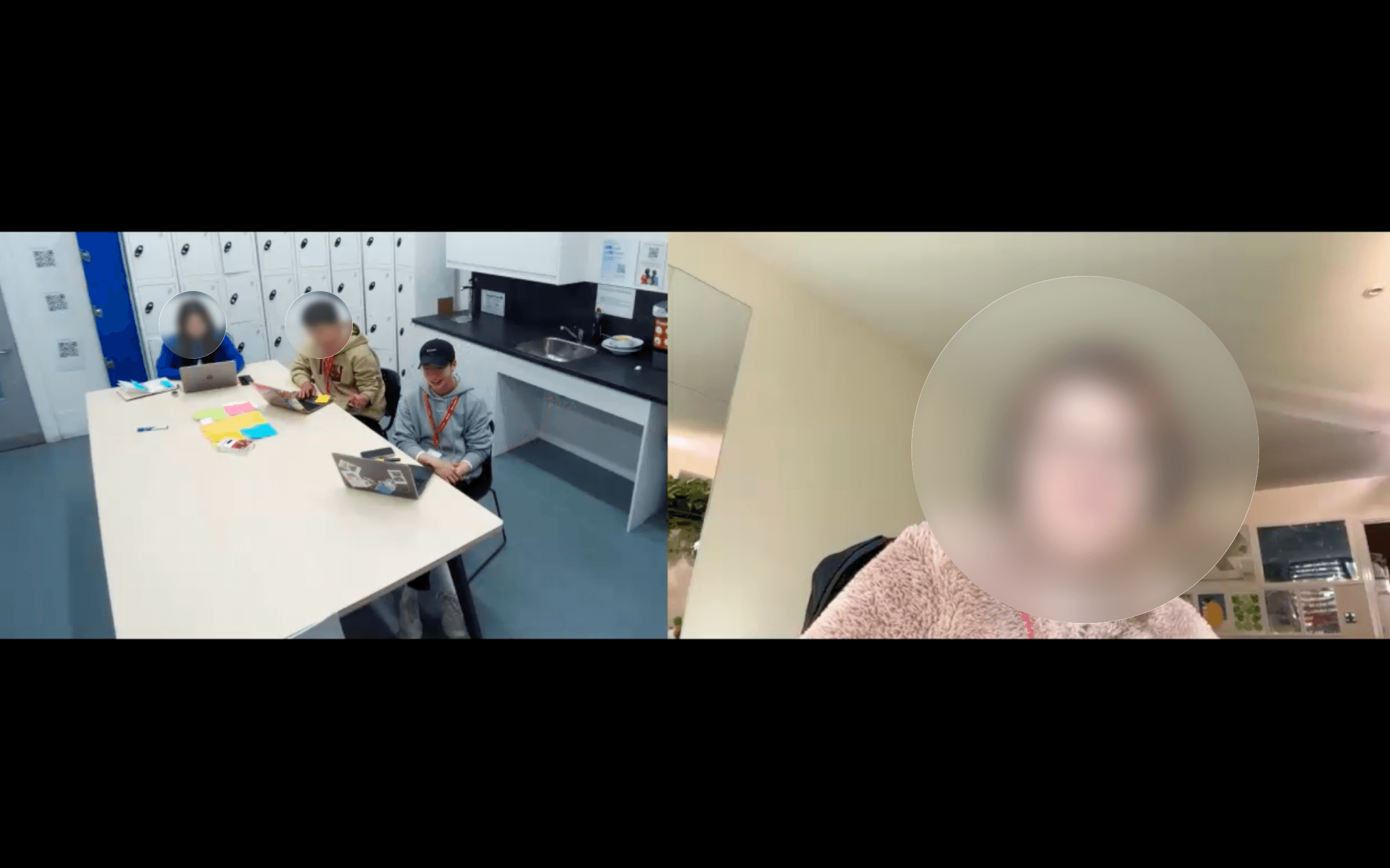
What testing exposed:
Users needed clearer guided flows, → imply structured onboarding and facilitation.
Users wanted decision-grade data (time, confidence, expectations) → implies pathway content designed for real choices.
Generic nudges underperformed → implies contextual personalisation and cohort-based benchmarks.
What testing validated:
Users respond best to nudges that feel like agency.
Pathway visualisation makes decisions feel tangible.
“Two skills away” framing increases perceived feasibility.
Adoption depends on trust, usability, and integration—not self-assessment alone.
Public user survey and stakeholder interview
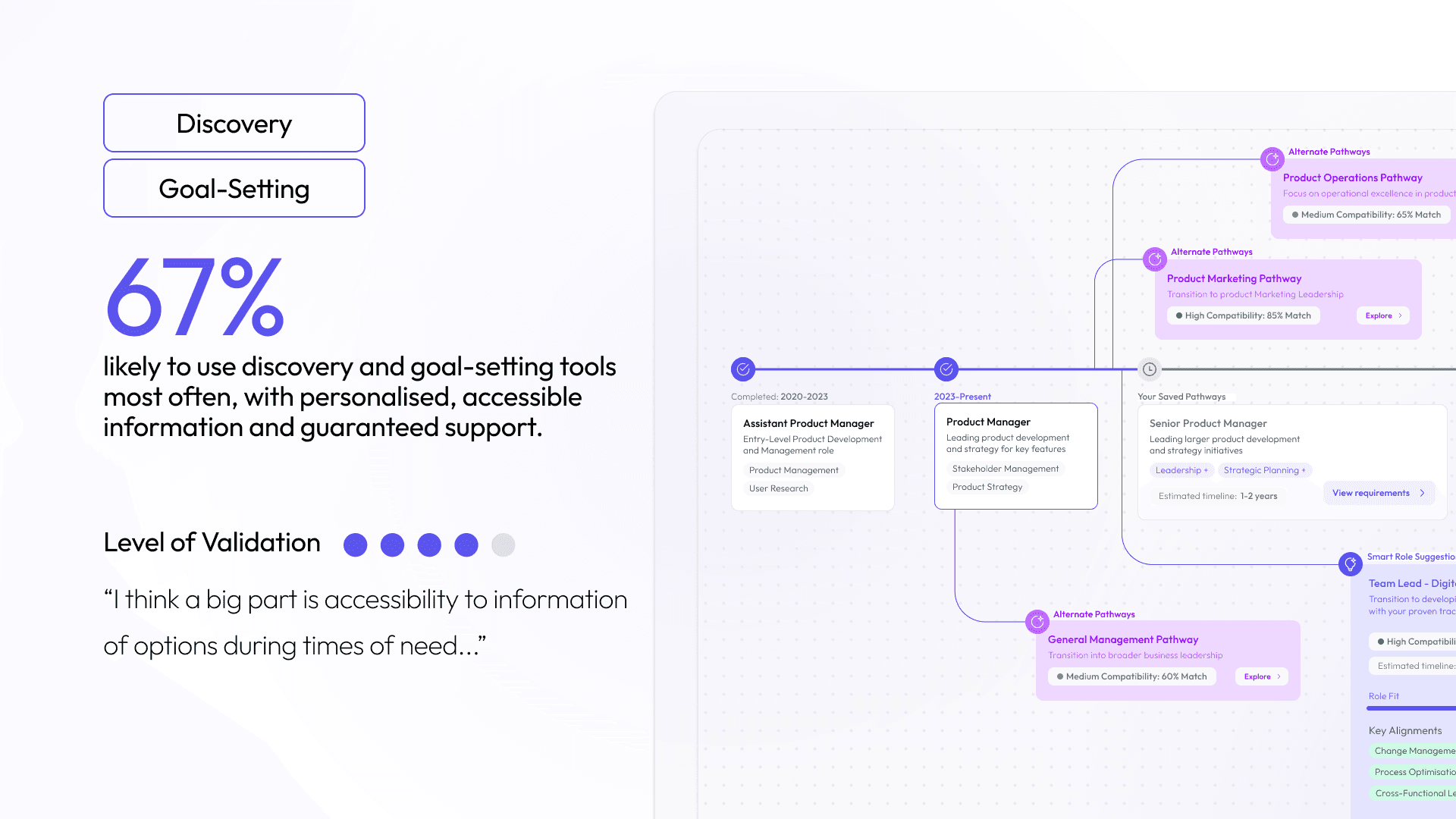
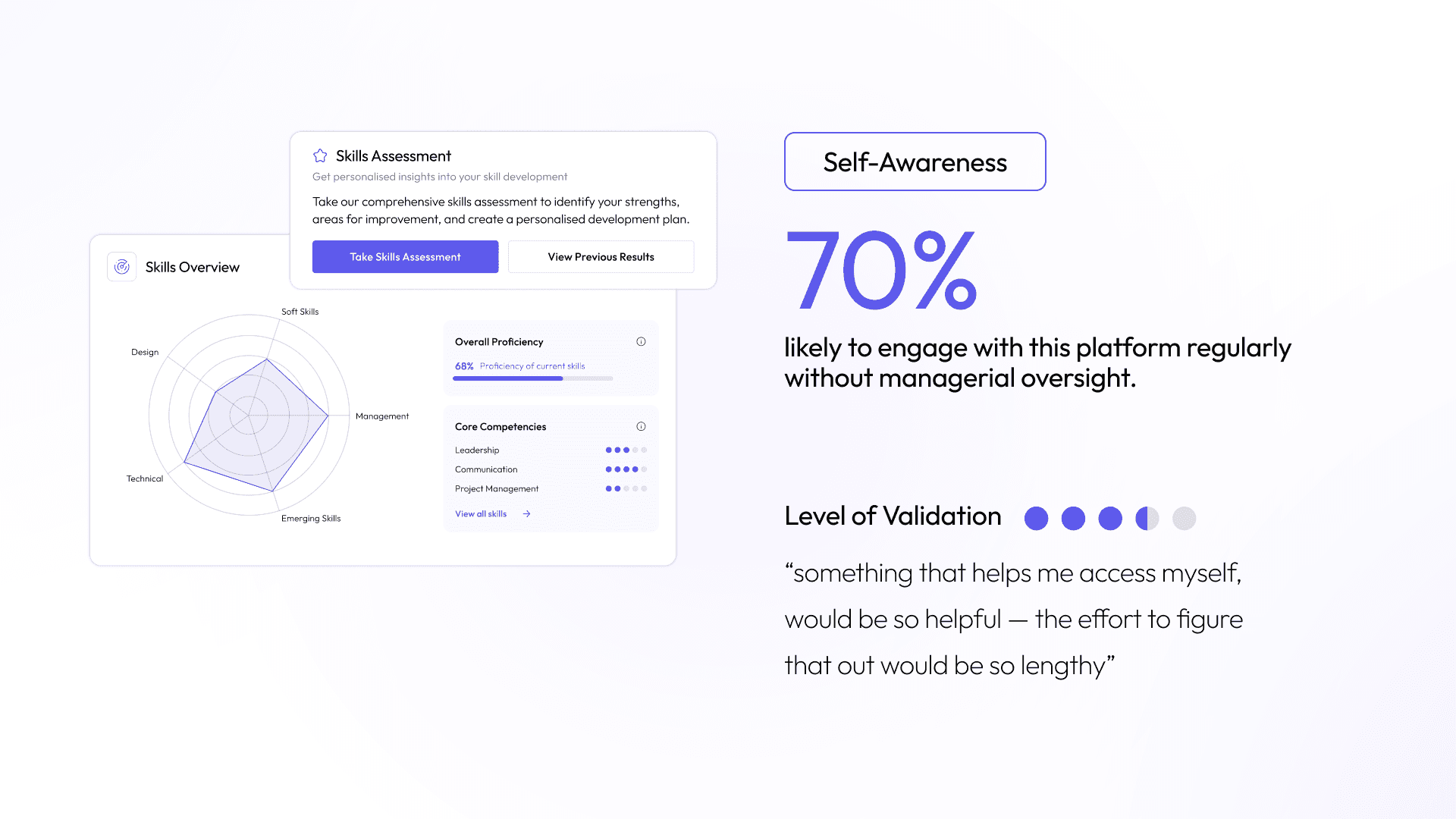
Survey participants ranged from staff and concierges at high-street banks to HR personnel to analysts in 4 UK banks.
The survey revealed that 70% of respondents would use FutureForge regularly without managerial oversight, and 67% favoured discovery and goal-setting tools as their top desired features. While demand is evident, the necessary infrastructure is lacking.
FutureForge
Overview
A Strategic Design Model for Internal Workforce Transitions in the Fourth Industrial Revolution
FutureForge is a strategic service model that helps UK retail banks move from reactive redeployment to proactive internal mobility by fixing four systemic failure modes: fragmented infrastructure, permission-led culture, low psychological safety, and ad-hoc workforce strategy.
It reframes workforce transition as a continuous journey (not a one-off event), aligning employee agency with strategic workforce planning through an integrated experience architecture, behavioural scaffolding, and governance touchpoints across HR, L&D, SWP, and line management.
Categories
Service Design
Design Strategy
Date
Jul 28, 2025
Client
Royal College of Art
Jump to:
(Click here to view full report)
Key signal:
Empathy‑driven, unified systems that use business objectives, needs, and trends to guide internal mobility and reskilling pathways are associated with higher retention and productivity while also reducing material redundancy and external recruitment costs per role.
Methods:
Multi-level analysis, interviews, system mapping, Multi-state personas + journey mapping, Behavioural modelling, Co-creation, Theory of Change, Service blueprinting.
Validation:
Employee Surveys, Prototype simulation workshop and Co-creation workshops with Financial Services Skills Commission (FSSC) indicate model soundness and signal adoption potential.
Read details below
Research and Discovery
Why retail banking?
Retail banking faces two primary structural challenges: routine-intensive tasks that are highly susceptible to automation and legacy infrastructure that impedes efficient adaptation. The consequences of role elimination extend beyond financial losses, with each unsuccessful redeployment averaging £49,100. Implementing mobility as an ongoing system, rather than as a standalone human resources initiative, enables banks to minimise unnecessary turnover and retain valuable institutional knowledge that is not easily replicated by competitors.
3 Key Discoveries and pillars for design
My team's research employed macro-level analysis, stakeholder interviews, system mapping, and journey mapping to investigate the persistent shortcomings of current transition initiatives. Three key findings informed the subsequent analysis and design needs.
Discovery 1
The barrier is navigability, not skills
Employees don't lack the potential to move. They lack the conditions that make movement feel safe, visible, and worth attempting. Across our research, transitions were described not as choices but as gambles — opaque role definitions, limited sight lines into realistic opportunities, and access determined more by who you knew than what you could do.
The design implication is precise: a transition system must do three things before it earns the right to offer training content. It must reduce uncertainty by clarifying what's possible. It must reduce social risk by creating environments where exploration doesn't carry professional consequences. And it must lower the effort of navigation through guided, structured progression — not a catalogue of courses, but a system that moves with the employee.
Expand
Discovery 2
Failure is systemic: four breakdowns reinforce each other
Research converged on four connected failure modes—showing why point solutions don’t stick:
Technical failure: HR, learning, performance, and vacancy data sit in silos, blocking role-readiness visibility.
Cultural failure: permission culture and top-down redeployment suppress proactive exploration.
Emotional failure: fear, fatigue, and low confidence reduce uptake even when options exist.
Strategic failure: ad-hoc initiatives without alignment across HR, L&D, SWP, and business units.
Implication: the intervention must be designed as a coordinated service ecosystem with clear decision rights—rather than a single platform feature set.
These failures explain why existing industry interventions, such as HSBC University, DBS Bank’s internal mobility platform, and Barclays’ career tools, have not resolved the problem. Each targets one dimension. Futureforge should aim to address all four.
Expand
Discovery 3
The solution must change behaviour, not just provide access
Transition behaves like behaviour change: people move from awareness → action → sustained habit. Interventions work best when tailored to readiness.
Testing signals supported three needs:
Guidance without removing agency, or at least it should allude to the feeling of having agency.
• Visual tools that reduce cognitive load, provide information and streamline guidance.
• Feasibility framing that makes action feel near-term and doable (e.g., “two skills away”).
Implication: the design must combine staged behavioural scaffolding with concrete operating mechanics (integration + governance + incentives).
Expand
Design Problem Statement:
Due to limited collaboration between leadership and employees, unclear frameworks for mapping emerging roles and skills, and a lack of employee-centric design in reskilling initiatives, mid-career banking employees are unable to navigate workforce transitions with clarity, confidence, and long-term support.
Developing a new strategic model
What exists, and what must change
Acknowledging the successes and limitations of existing models, paired with the insights, principles and discoveries made. FutureForge is a strategic model designed to strike a balance between achieving human empathy and embedding it in TMS/HRMS services that help mid-career employees anticipate change, explore realistic pathways, and build role-readiness, while enabling HR/SWP to plan with better skills visibility and internal deployment signals.
The problem is not that banks lack tools for workforce transition.
The problem is that existing tools are positioned after the crisis, rather than before it. Employees receive support only after a disruption has occurred, by which point trust is already broken.
Our multi-actor journey map and system mapping revealed five interconnected feedback loops shaping how transitions succeed or fail: growth and engagement, skill visibility and matching, career clarity, leadership trust, and reskilling and mobility. At the centre of all five sit two structural barriers: cultural and top-down control, and system fragmentation.
How might we help banking professionals navigate workforce transitions while fostering collaboration between employees and leadership, clarifying pathways to emerging roles and skills, and enabling employee-centred reskilling?”
Mechanisms of Change
How and why this works
Designing with behaviour mechanisms ensures users can move
from reactivity to proactivity
Services created with human empathy increase the likelihood of achieving business goals.
Change takes intentional steps
The shift Futureforge proposes is not a feature upgrade. It is a reframing: from transition as an event to transition as a continuous, supported journey. From one-time reskilling to proactive career development. From passive notification to active employee agency.
The most significant design intervention is not what happens during the trigger; it is what happens before it. Employees who have already mapped their skills, explored adjacent roles, and set career goals will be able to respond to disruption with confidence rather than react in panic.
The future of HRMS systems
Designing features needed in Futureforge
The service operates across three behavioural stages, mirroring how people actually navigate change.
Based on Prochaska’s Stages of Change and Fogg’s Behaviour Model, each stage has distinct emotional and cognitive needs. Our platform’s features are calibrated to meet people where they are.
Stage 1
Self-Awareness
Most employees do not know their role is at risk until it is already being restructured. The first design challenge is making invisible risk visible, without triggering panic.
FutureForge’s Skills Snapshot tool draws on performance data, HR records, and live market intelligence to generate a personalised skill profile. Empathetic nudges — framed as opportunities rather than warnings — surface skill obsolescence before it becomes a crisis. An Emergency Mode activates targeted support for employees identified as high-displacement risk, providing immediate action plans and coaching referrals.
Our prototype testing validated a key hypothesis: when transitions are framed as near-term, achievable steps rather than distant threats, employees are significantly more likely to take action. The prompt “you are two skills away from this role” outperformed generic pathway recommendations in every test.
Stage 2
Discovery and Goal Setting
Awareness is not enough. Employees who understand their skill gaps still face a second barrier: they cannot visualise what their future could look like, so they cannot commit to a direction.
The Career Pathways Visualiser maps realistic transition routes based on each employee’s current profile, adjacent skill clusters, and historical mobility data from comparable colleagues. Comparison Profiles — anonymised stories of employees who made similar moves — make possible futures tangible and relatable. A Live Skills Heatmap shows which capabilities are rising or declining in market demand, grounding personal decisions in external reality.
This combination addresses the most persistent gap identified in our FSSC co-creation workshop: employees want to make proactive decisions but need trusted data and real examples to do so. Vague future-of-work messaging does not change behaviour. Specific, personal, evidence-grounded options do.
Stage 3
Continuous Development
The most common point of failure in reskilling programmes is not the start — it is the middle. Once initial motivation fades and new behaviours are not yet habitual, employees disengage. Existing tools provide no support at this stage.
FutureForge addresses this through a Personal Development Dashboard that tracks progress against selected goals, integrates learning recommendations from the internal LMS, and connects employees with peer mentors who have completed comparable transitions. Progress milestones trigger recognition, reinforcing behaviour at the precise moment it is most fragile.
For HR and L&D teams, this stage provides the clearest organisational value: real-time visibility into employee intent, capability gaps by team and department, and automated alignment between individual development plans and Strategic Workforce Planning forecasts.
Validation and Co-design
What was learnt and what changed
What testing exposed:
Users needed clearer guided flows, → imply structured onboarding and facilitation.
Users wanted decision-grade data (time, confidence, expectations) → implies pathway content designed for real choices.
Generic nudges underperformed → implies contextual personalisation and cohort-based benchmarks.
What testing validated:
Users respond best to nudges that feel like agency.
Pathway visualisation makes decisions feel tangible.
“Two skills away” framing increases perceived feasibility.
Adoption depends on trust, usability, and integration—not self-assessment alone.
Public user survey and stakeholder interview
Survey participants ranged from staff and concierges at high-street banks to HR personnel to analysts in 4 UK banks.
The survey revealed that 70% of respondents would use FutureForge regularly without managerial oversight, and 67% favoured discovery and goal-setting tools as their top desired features. While demand is evident, the necessary infrastructure is lacking.
FutureForge
Overview
A Strategic Design Model for Internal Workforce Transitions in the Fourth Industrial Revolution
FutureForge is a strategic service model that helps UK retail banks move from reactive redeployment to proactive internal mobility by fixing four systemic failure modes: fragmented infrastructure, permission-led culture, low psychological safety, and ad-hoc workforce strategy.
It reframes workforce transition as a continuous journey (not a one-off event), aligning employee agency with strategic workforce planning through an integrated experience architecture, behavioural scaffolding, and governance touchpoints across HR, L&D, SWP, and line management.
Categories
Service Design
Design Strategy
Date
Jul 28, 2025
Client
Royal College of Art
Jump to:
(Click here to view full report)
Key signal:
Empathy‑driven, unified systems that use business objectives, needs, and trends to guide internal mobility and reskilling pathways are associated with higher retention and productivity while also reducing material redundancy and external recruitment costs per role.
Methods:
Multi-level analysis, interviews, system mapping, Multi-state personas + journey mapping, Behavioural modelling, Co-creation, Theory of Change, Service blueprinting.
Validation:
Employee Surveys, Prototype simulation workshop and Co-creation workshops with Financial Services Skills Commission (FSSC) indicate model soundness and signal adoption potential.
Read details below
Research and Discovery
Why retail banking?
Retail banking faces two primary structural challenges: routine-intensive tasks that are highly susceptible to automation and legacy infrastructure that impedes efficient adaptation. The consequences of role elimination extend beyond financial losses, with each unsuccessful redeployment averaging £49,100. Implementing mobility as an ongoing system, rather than as a standalone human resources initiative, enables banks to minimise unnecessary turnover and retain valuable institutional knowledge that is not easily replicated by competitors.
3 Key Discoveries and pillars for design
My team's research employed macro-level analysis, stakeholder interviews, system mapping, and journey mapping to investigate the persistent shortcomings of current transition initiatives. Three key findings informed the subsequent analysis and design needs.
Discovery 1
The barrier is navigability, not skills
Employees don't lack the potential to move. They lack the conditions that make movement feel safe, visible, and worth attempting. Across our research, transitions were described not as choices but as gambles — opaque role definitions, limited sight lines into realistic opportunities, and access determined more by who you knew than what you could do.
The design implication is precise: a transition system must do three things before it earns the right to offer training content. It must reduce uncertainty by clarifying what's possible. It must reduce social risk by creating environments where exploration doesn't carry professional consequences. And it must lower the effort of navigation through guided, structured progression — not a catalogue of courses, but a system that moves with the employee.
Expand
Discovery 2
Failure is systemic: four breakdowns reinforce each other
Research converged on four connected failure modes—showing why point solutions don’t stick:
Technical failure: HR, learning, performance, and vacancy data sit in silos, blocking role-readiness visibility.
Cultural failure: permission culture and top-down redeployment suppress proactive exploration.
Emotional failure: fear, fatigue, and low confidence reduce uptake even when options exist.
Strategic failure: ad-hoc initiatives without alignment across HR, L&D, SWP, and business units.
Implication: the intervention must be designed as a coordinated service ecosystem with clear decision rights—rather than a single platform feature set.
These failures explain why existing industry interventions, such as HSBC University, DBS Bank’s internal mobility platform, and Barclays’ career tools, have not resolved the problem. Each targets one dimension. Futureforge should aim to address all four.
Expand
Discovery 3
The solution must change behaviour, not just provide access
Transition behaves like behaviour change: people move from awareness → action → sustained habit. Interventions work best when tailored to readiness.
Testing signals supported three needs:
Guidance without removing agency, or at least it should allude to the feeling of having agency.
• Visual tools that reduce cognitive load, provide information and streamline guidance.
• Feasibility framing that makes action feel near-term and doable (e.g., “two skills away”).
Implication: the design must combine staged behavioural scaffolding with concrete operating mechanics (integration + governance + incentives).
Expand
Design Problem Statement:
Due to limited collaboration between leadership and employees, unclear frameworks for mapping emerging roles and skills, and a lack of employee-centric design in reskilling initiatives, mid-career banking employees are unable to navigate workforce transitions with clarity, confidence, and long-term support.
Developing a new strategic model
What exists, and what must change
Acknowledging the successes and limitations of existing models, paired with the insights, principles and discoveries made. FutureForge is a strategic model designed to strike a balance between achieving human empathy and embedding it in TMS/HRMS services that help mid-career employees anticipate change, explore realistic pathways, and build role-readiness, while enabling HR/SWP to plan with better skills visibility and internal deployment signals.
The problem is not that banks lack tools for workforce transition.
The problem is that existing tools are positioned after the crisis, rather than before it. Employees receive support only after a disruption has occurred, by which point trust is already broken.
Our multi-actor journey map and system mapping revealed five interconnected feedback loops shaping how transitions succeed or fail: growth and engagement, skill visibility and matching, career clarity, leadership trust, and reskilling and mobility. At the centre of all five sit two structural barriers: cultural and top-down control, and system fragmentation.
How might we help banking professionals navigate workforce transitions while fostering collaboration between employees and leadership, clarifying pathways to emerging roles and skills, and enabling employee-centred reskilling?”
Mechanisms of Change
How and why this works
Designing with behaviour mechanisms ensures users can move
from reactivity to proactivity
Services created with human empathy increase the likelihood of achieving business goals.
Change takes intentional steps
The shift Futureforge proposes is not a feature upgrade. It is a reframing: from transition as an event to transition as a continuous, supported journey. From one-time reskilling to proactive career development. From passive notification to active employee agency.
The most significant design intervention is not what happens during the trigger; it is what happens before it. Employees who have already mapped their skills, explored adjacent roles, and set career goals will be able to respond to disruption with confidence rather than react in panic.
The future of HRMS systems
Designing features needed in Futureforge
The service operates across three behavioural stages, mirroring how people actually navigate change.
Based on Prochaska’s Stages of Change and Fogg’s Behaviour Model, each stage has distinct emotional and cognitive needs. Our platform’s features are calibrated to meet people where they are.
Stage 1
Self-Awareness
Most employees do not know their role is at risk until it is already being restructured. The first design challenge is making invisible risk visible, without triggering panic.
FutureForge’s Skills Snapshot tool draws on performance data, HR records, and live market intelligence to generate a personalised skill profile. Empathetic nudges — framed as opportunities rather than warnings — surface skill obsolescence before it becomes a crisis. An Emergency Mode activates targeted support for employees identified as high-displacement risk, providing immediate action plans and coaching referrals.
Our prototype testing validated a key hypothesis: when transitions are framed as near-term, achievable steps rather than distant threats, employees are significantly more likely to take action. The prompt “you are two skills away from this role” outperformed generic pathway recommendations in every test.
Stage 2
Discovery and Goal Setting
Awareness is not enough. Employees who understand their skill gaps still face a second barrier: they cannot visualise what their future could look like, so they cannot commit to a direction.
The Career Pathways Visualiser maps realistic transition routes based on each employee’s current profile, adjacent skill clusters, and historical mobility data from comparable colleagues. Comparison Profiles — anonymised stories of employees who made similar moves — make possible futures tangible and relatable. A Live Skills Heatmap shows which capabilities are rising or declining in market demand, grounding personal decisions in external reality.
This combination addresses the most persistent gap identified in our FSSC co-creation workshop: employees want to make proactive decisions but need trusted data and real examples to do so. Vague future-of-work messaging does not change behaviour. Specific, personal, evidence-grounded options do.
Stage 3
Continuous Development
The most common point of failure in reskilling programmes is not the start — it is the middle. Once initial motivation fades and new behaviours are not yet habitual, employees disengage. Existing tools provide no support at this stage.
FutureForge addresses this through a Personal Development Dashboard that tracks progress against selected goals, integrates learning recommendations from the internal LMS, and connects employees with peer mentors who have completed comparable transitions. Progress milestones trigger recognition, reinforcing behaviour at the precise moment it is most fragile.
For HR and L&D teams, this stage provides the clearest organisational value: real-time visibility into employee intent, capability gaps by team and department, and automated alignment between individual development plans and Strategic Workforce Planning forecasts.
Validation and Co-design
What was learnt and what changed
What testing exposed:
Users needed clearer guided flows, → imply structured onboarding and facilitation.
Users wanted decision-grade data (time, confidence, expectations) → implies pathway content designed for real choices.
Generic nudges underperformed → implies contextual personalisation and cohort-based benchmarks.
What testing validated:
Users respond best to nudges that feel like agency.
Pathway visualisation makes decisions feel tangible.
“Two skills away” framing increases perceived feasibility.
Adoption depends on trust, usability, and integration—not self-assessment alone.
Public user survey and stakeholder interview
Survey participants ranged from staff and concierges at high-street banks to HR personnel to analysts in 4 UK banks.
The survey revealed that 70% of respondents would use FutureForge regularly without managerial oversight, and 67% favoured discovery and goal-setting tools as their top desired features. While demand is evident, the necessary infrastructure is lacking.