
Moss Air Filtration Ecosystem
Overview
A community resilience ecosystem addressing ultrafine particle (UFP) pollution from Heathrow,
integrating biofiltration, education, monitoring, and policy into one reinforcing system.
Categories
Social Innovation
Product Innovation
Date
12 Feb, 2025
Client
London Borough of Hounslow, Royal College of Art
Recognition:
Best Research Practice, Top 5 of 120+ teams
Methods:
Literature review, air quality data analysis including Heathrow-provided UFP monitoring data, site visits, community resident interviews, stakeholder mapping, scientific benchmarking of biofiltration materials
Key signal:
3.5 million people live under Heathrow’s flight path.
Since the third runway has now been approved and daily flights are about to nearly double, my team has created an ecosystem which enables Hounslow to have cleaner air today and at the same time provides the necessary evidence, awareness, and agreement within institutions so that its most invisible pollutant will no longer be ignorable tomorrow.


What was delivered:
A Community-Scale Biofiltration Response to Ultrafine Particle Pollution (UFP) in Hounslow
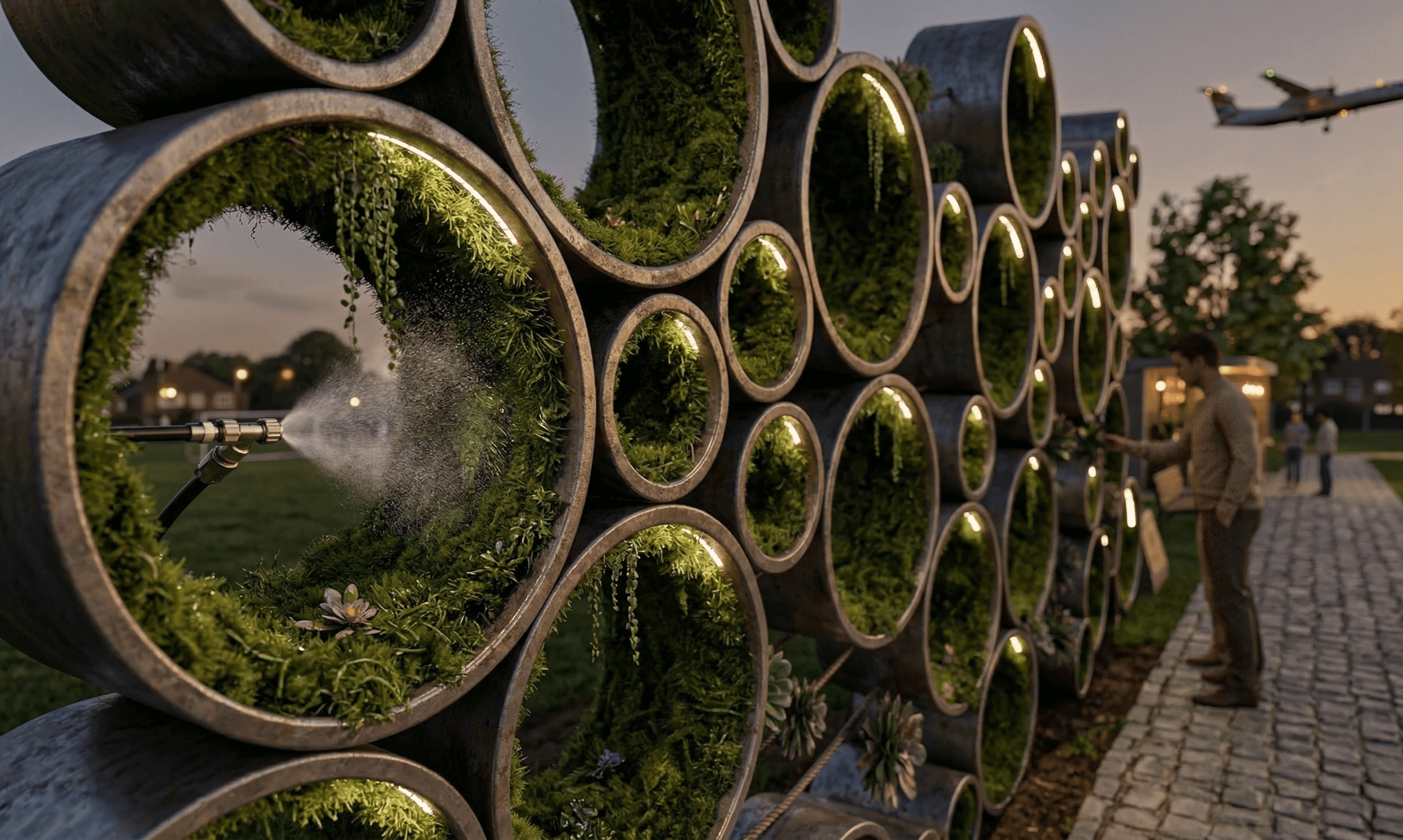
Moss Air Filtration Ecosystem is a product-service solution that helps the London Borough of Hounslow. It is designed to create an ecosystem that protects residents and children from UFP exposure and builds long-term public awareness, while creating the monitoring infrastructure and institutional partnerships needed to drive policy change
It reframes UFP mitigation as a continuous ecosystem, aligning community stewardship with local authority strategy, enabled by a modular biofiltration wall system, a stakeholder engagement framework, a deployment strategy, and real-time air quality monitoring across residential, civic, and transit-adjacent spaces.
Read details below
Research and Discovery
The problem nobody is measuring
Hounslow has been fighting air quality since it was declared an Air Quality Management Area in 2002. Progress has been real — NO₂ levels have fallen, PM2.5 is trending down, schools are being accredited. The borough's Air Quality Action Plan 2023–2028 sets 90 actions across transport, emissions, and public awareness. The intent is serious.
But UFPs — ultrafine particles from aircraft engines — are absent from all of it. Not because they are absent from the air. Because no regulation requires their measurement.

These particles are less than 100 nanometres wide, roughly 1,000 times smaller than a human hair. They pass through the lungs directly into the bloodstream, and are linked to high blood pressure, diabetes, dementia, and in children, impaired learning, memory, and motor development. Near Europe's 32 busiest airports, UFP exposure contributes to 280,000 cases of high blood pressure, 330,000 cases of diabetes, and 18,000 cases of dementia. There are 75 national monitoring sites for PM2.5. There are four for UFPs.
Hounslow's own AQAP acknowledges the borough sees disproportionately high emissions from aviation compared to the rest of London. But without a regulatory framework for UFPs, the council has no mandate to act — and no data with which to make the case for one.
So we posed the question:
|
"How do you address a health risk the system isn't designed to acknowledge?"
Systems Design
Designing the system alongside the product
The insight that shaped everything: the UFP problem can’t be solved by a single intervention. It needs a feedback loop, where each part makes the next more effective. Filtration cuts exposure. Education builds the stewardship that sustains the infrastructure. Monitoring generates the UFP data no institution currently holds at usable scale. And that data feeds the policy case that brings UFPs into regulation at last.
As the service designer on the team, my role was to see the whole system, to map the stakeholders, find the leverage points, and design an ecosystem where the components compound rather than run in parallel.

The ecosystem as a closed loop, we placed the moss structure at the centre, where it feeds data collected to research partners, which then informs government, shaping policy,
all while improving the air the community breathes.
For this project we proposed to start with schools as it is the one place where health impact, community trust, educational reach, and funding all converge.
Product innovation, backed by field research
The Artefact
The structure at the centre of the ecosystem is the result of scientific benchmarking, not assumption. Moss is 3.8× more effective than trees at removing ultrafine particles, its dense fibrous surface and moisture retention trap UFPs through ion exchange, while microorganisms in the wax biofilm break them down inside the cell itself.
Existing moss solutions hold roughly 4 m² of moss and need electricity.
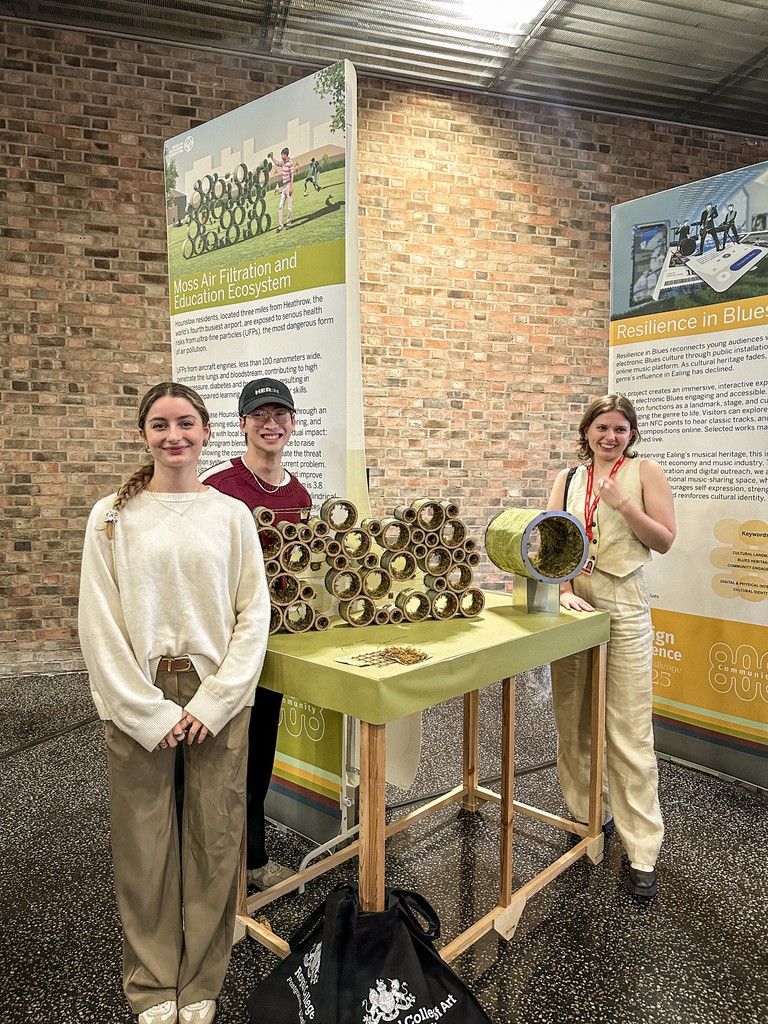
Ours holds 14.6 m², is fully passive, and stands 2 m tall – filtering at breathing height. The cylindrical form maximises particle capture through Brownian motion without obstructing airflow or requiring invasive installation.


1:1 and 1:5 scale working model, exhibited at the RCA Grand Challenge showcase.
3.8 x
more effective than trees at removing UFPs
14.6 m²
moss surface area per unit vs ~4 m² in existing solutions
2m
tall, a height tuned to filter at human breathing height
0w
energy input, fully passive,
"maintenance-light"
Designed to advance the Borough’s own agenda
Aligned with Hounslow’s strategy
The ecosystem wasn’t designed apart from the borough’s plans, my aim was to design in order to deliver on them. Grounding the concept in Hounslow’s live strategy documents turned an academic brief into a credible, adoptable proposal.
Greener, healthier, cleaner
The borough’s core vision;
Moss improves air quality in the spaces most-used by its most vulnerable residents.
London Borough of Hounslow's Corporate Plan
Air quality in & around schools
An explicit AQAP priority, alongside expanding monitoring and public awareness which three of the four things this ecosystem does.
Air Quality Action Plan 2023–2028
A hub for green innovation
The borough’s investment prospectus positions it to lead on environment, this project is a science-backed product innovation which gives it something to lead with.
Opportunity Hounslow
Tackling the climate emergency
A passive, nature-based green intervention that fits the borough’s long-term placemaking and sustainability commitments.
Local Plan 2020–2041
Replicable by design
Built to scale beyond one borough
Hounslow is just merely the starting point, the pilot.
As UFPs are an unregulated, under-monitored, under-researched problem at every airport community in the UK and the same modular structure, education programme, and monitoring framework travel to any of them.
Our advisors from with Imperial College London and King’s College London, validated and affirmed our approach of design that each deployed unit could double as a monitoring node and be able to contribute to a distributed evidence base that doesn’t yet exist in the UK and worldwide.
Funding aligns with Heathrow’s 2030 emissions goals and the Clean Air Fund for schools. That evidence is what builds the regulatory case and regulation is what makes the intervention, one day, unnecessary.
Our design choice is intentional, aiming for our artefact to be easy to manufacture and replicable nationwide.
If implemented well, this system is designed persist with time.
My role and what I led
My contribution concentrated on research synthesis, the service-design and futures design process. as well as the systemic framing that turned this broad brief into a defensible ecosystem, and also on the narrative and storytelling.
[Drag to View]
Research synthesis
Process facilitation
Field & cross-border research
Systems & narrative
Story & delivery
Moss Air Filtration Ecosystem
Overview
A community resilience ecosystem addressing ultrafine particle (UFP) pollution from Heathrow,
integrating biofiltration, education, monitoring, and policy into one reinforcing system.
Categories
Social Innovation
Product Innovation
Date
12 Feb, 2025
Client
London Borough of Hounslow, Royal College of Art
Recognition:
Best Research Practice, Top 5 of 120+ teams
Methods:
Literature review, air quality data analysis including Heathrow-provided UFP monitoring data, site visits, community resident interviews, stakeholder mapping, scientific benchmarking of biofiltration materials
Key signal:
3.5 million people live under Heathrow’s flight path.
Since the third runway has now been approved and daily flights are about to nearly double, my team has created an ecosystem which enables Hounslow to have cleaner air today and at the same time provides the necessary evidence, awareness, and agreement within institutions so that its most invisible pollutant will no longer be ignorable tomorrow.
What was delivered:
A Community-Scale Biofiltration Response to Ultrafine Particle Pollution (UFP) in Hounslow
Moss Air Filtration Ecosystem is a product-service solution that helps the London Borough of Hounslow. It is designed to create an ecosystem that protects residents and children from UFP exposure and builds long-term public awareness, while creating the monitoring infrastructure and institutional partnerships needed to drive policy change
It reframes UFP mitigation as a continuous ecosystem, aligning community stewardship with local authority strategy, enabled by a modular biofiltration wall system, a stakeholder engagement framework, a deployment strategy, and real-time air quality monitoring across residential, civic, and transit-adjacent spaces.
Read details below
Research and Discovery
The problem nobody is measuring
Hounslow has been fighting air quality since it was declared an Air Quality Management Area in 2002. Progress has been real though, NO₂ levels have fallen, PM2.5 is trending down, schools are being accredited. The borough's Air Quality Action Plan 2023–2028 sets 90 actions across transport, emissions, and public awareness. The intent is serious.
But UFPs (ultrafine particles) from aircraft engines are absent from all of it. Not because they are absent from the air but because no regulation requires their measurement.
These particles are less than 100 nanometres wide, roughly 1,000 times smaller than a human hair. They pass through the lungs directly into the bloodstream, and are linked to high blood pressure, diabetes, dementia, and in children, impaired learning, memory, and motor development. Near Europe's 32 busiest airports, UFP exposure contributes to 280,000 cases of high blood pressure, 330,000 cases of diabetes, and 18,000 cases of dementia. There are 75 national monitoring sites for PM2.5. There are four for UFPs.
Hounslow's own AQAP acknowledges the borough sees disproportionately high emissions from aviation compared to the rest of London. But without a regulatory framework for UFPs, the council has no mandate to act — and no data with which to make the case for one.
So we posed the question:
|
"How do you address a health risk the system isn't designed to acknowledge?"
Systems Design
Designing the system alongside the product
The insight that shaped everything: the UFP problem can’t be solved by a single intervention. It needs a feedback loop, where each part makes the next more effective. Filtration cuts exposure. Education builds the stewardship that sustains the infrastructure. Monitoring generates the UFP data no institution currently holds at usable scale. And that data feeds the policy case that brings UFPs into regulation at last.
As the service designer on the team, my role was to see the whole system, to map the stakeholders, find the leverage points, and design an ecosystem where the components compound rather than run in parallel.
The ecosystem as a closed loop, we placed the moss structure at the centre, where it feeds data collected to research partners, which then informs government, shaping policy, all while improving the air the community breathes.
For this project we proposed to start with schools as it is the one place where health impact, community trust, educational reach, and funding all converge.
Product innovation, backed by field research
The Artefact
The structure at the centre of the ecosystem is the result of scientific benchmarking, not assumption. Moss is 3.8× more effective than trees at removing ultrafine particles, its dense fibrous surface and moisture retention trap UFPs through ion exchange, while microorganisms in the wax biofilm break them down inside the cell itself.
Existing moss solutions hold roughly 4 m² of moss and need electricity.
Ours holds 14.6 m², is fully passive, and stands 2 m tall – filtering at breathing height. The cylindrical form maximises particle capture through Brownian motion without obstructing airflow or requiring invasive installation.
1:1 and 1:5 scale working model, exhibited at the RCA Grand Challenge showcase.
3.8 x
more effective than trees at removing UFPs
14.6 m²
moss surface area per unit vs ~4 m² in existing solutions
2m
tall, a height tuned to filter at human breathing height
0w
energy input, fully passive,
"maintenance-light"
Designed to advance the Borough’s own agenda
Aligned with Hounslow’s strategy
The ecosystem wasn’t designed apart from the borough’s plans, my aim was to design in order to deliver on them. Grounding the concept in Hounslow’s live strategy documents turned an academic brief into a credible, adoptable proposal.
Greener, healthier, cleaner
The borough’s core vision;
Moss improves air quality in the spaces most-used by its most vulnerable residents.
London Borough of Hounslow's Corporate Plan
Air quality in & around schools
An explicit AQAP priority, alongside expanding monitoring and public awareness which three of the four things this ecosystem does.
Air Quality Action Plan 2023–2028
A hub for green innovation
The borough’s investment prospectus positions it to lead on environment, this project is a science-backed product innovation which gives it something to lead with.
Opportunity Hounslow
Tackling the climate emergency
A passive, nature-based green intervention that fits the borough’s long-term placemaking and sustainability commitments.
Local Plan 2020–2041
Replicable by design
Built to scale beyond one borough
Hounslow is just merely the starting point, the pilot.
As UFPs are an unregulated, under-monitored, under-researched problem at every airport community in the UK and the same modular structure, education programme, and monitoring framework travel to any of them.
Our advisors from with Imperial College London and King’s College London, validated and affirmed our approach of design that each deployed unit could double as a monitoring node and be able to contribute to a distributed evidence base that doesn’t yet exist in the UK and worldwide.
Funding aligns with Heathrow’s 2030 emissions goals and the Clean Air Fund for schools. That evidence is what builds the regulatory case and regulation is what makes the intervention, one day, unnecessary.
Our design choice is intentional, aiming for our artefact to be easy to manufacture and replicable nationwide.
If implemented well, this system is designed to persist with time.
My role and what I led
My contribution concentrated on research synthesis, the service-design and futures design process. as well as the systemic framing that turned this broad brief into a defensible ecosystem, and also on the narrative and storytelling.
[Drag to View]
Research synthesis
Broke down Hounslow’s Annual Status Reports, Air Quality Action Plan, and economic & environmental strategy documents to locate the regulatory gap the project would target.
Process facilitation
Set direction and facilitated the team through service-design tools and methodology across the ideation, insight, and gateway phases.
Field & cross-border research
Ran ground research and resident interviews in the borough, and led comparative research into similar interventions elsewhere.
Systems & narrative
Mapped the ecosystem into a single reinforcing loop and crafted the narrative, key findings, and story structure for the final presentation.
Story & delivery
Wrote and edited the script and voiceover, and produced the animation and storytelling for the final crit presentation and team film.
Moss Air Filtration Ecosystem
Overview
A community resilience ecosystem addressing ultrafine particle (UFP) pollution from Heathrow,
integrating biofiltration, education, monitoring, and policy into one reinforcing system.
Categories
Social Innovation
Product Innovation
Date
12 Feb, 2025
Client
London Borough of Hounslow, Royal College of Art
Recognition:
Best Research Practice, Top 5 of 120+ teams
Methods:
Literature review, air quality data analysis including Heathrow-provided UFP monitoring data, site visits, community resident interviews, stakeholder mapping, scientific benchmarking of biofiltration materials
Key signal:
3.5 million people live under Heathrow’s flight path.
Since the third runway has now been approved and daily flights are about to nearly double, my team has created an ecosystem which enables Hounslow to have cleaner air today and at the same time provides the necessary evidence, awareness, and agreement within institutions so that its most invisible pollutant will no longer be ignorable tomorrow.
What was delivered:
A Community-Scale Biofiltration Response to Ultrafine Particle Pollution (UFP) in Hounslow
Moss Air Filtration Ecosystem is a product-service solution that helps the London Borough of Hounslow. It is designed to create an ecosystem that protects residents and children from UFP exposure and builds long-term public awareness, while creating the monitoring infrastructure and institutional partnerships needed to drive policy change
It reframes UFP mitigation as a continuous ecosystem, aligning community stewardship with local authority strategy, enabled by a modular biofiltration wall system, a stakeholder engagement framework, a deployment strategy, and real-time air quality monitoring across residential, civic, and transit-adjacent spaces.
Read details below
Research and Discovery
The problem nobody is measuring
Hounslow has been fighting air quality since it was declared an Air Quality Management Area in 2002. Progress has been real — NO₂ levels have fallen, PM2.5 is trending down, schools are being accredited. The borough's Air Quality Action Plan 2023–2028 sets 90 actions across transport, emissions, and public awareness. The intent is serious.
But UFPs — ultrafine particles from aircraft engines — are absent from all of it. Not because they are absent from the air. Because no regulation requires their measurement.
These particles are less than 100 nanometres wide, roughly 1,000 times smaller than a human hair. They pass through the lungs directly into the bloodstream, and are linked to high blood pressure, diabetes, dementia, and in children, impaired learning, memory, and motor development. Near Europe's 32 busiest airports, UFP exposure contributes to 280,000 cases of high blood pressure, 330,000 cases of diabetes, and 18,000 cases of dementia. There are 75 national monitoring sites for PM2.5. There are four for UFPs.
Hounslow's own AQAP acknowledges the borough sees disproportionately high emissions from aviation compared to the rest of London. But without a regulatory framework for UFPs, the council has no mandate to act — and no data with which to make the case for one.
So we posed the question:
|
"How do you address a health risk the system isn't designed to acknowledge?"
Systems Design
Designing the system alongside the product
The insight that shaped everything: the UFP problem can’t be solved by a single intervention. It needs a feedback loop, where each part makes the next more effective. Filtration cuts exposure. Education builds the stewardship that sustains the infrastructure. Monitoring generates the UFP data no institution currently holds at usable scale. And that data feeds the policy case that brings UFPs into regulation at last.
As the service designer on the team, my role was to see the whole system, to map the stakeholders, find the leverage points, and design an ecosystem where the components compound rather than run in parallel.
The ecosystem as a closed loop, we placed the moss structure at the centre, where it feeds data collected to research partners, which then informs government, shaping policy,
all while improving the air the community breathes.
For this project we proposed to start with schools as it is the one place where health impact, community trust, educational reach, and funding all converge.
Product innovation, backed by field research
The Artefact
The structure at the centre of the ecosystem is the result of scientific benchmarking, not assumption. Moss is 3.8× more effective than trees at removing ultrafine particles, its dense fibrous surface and moisture retention trap UFPs through ion exchange, while microorganisms in the wax biofilm break them down inside the cell itself.
Existing moss solutions hold roughly 4 m² of moss and need electricity.
Ours holds 14.6 m², is fully passive, and stands 2 m tall – filtering at breathing height. The cylindrical form maximises particle capture through Brownian motion without obstructing airflow or requiring invasive installation.
1:1 and 1:5 scale working model, exhibited at the RCA Grand Challenge showcase.
3.8 x
more effective than trees at removing UFPs
14.6 m²
moss surface area per unit vs ~4 m² in existing solutions
2m
tall, a height tuned to filter at human breathing height
0w
energy input, fully passive,
"maintenance-light"
Designed to advance the Borough’s own agenda
Aligned with Hounslow’s strategy
The ecosystem wasn’t designed apart from the borough’s plans, my aim was to design in order to deliver on them. Grounding the concept in Hounslow’s live strategy documents turned an academic brief into a credible, adoptable proposal.
Greener, healthier, cleaner
The borough’s core vision;
Moss improves air quality in the spaces most-used by its most vulnerable residents.
London Borough of Hounslow's Corporate Plan
Air quality in & around schools
An explicit AQAP priority, alongside expanding monitoring and public awareness which three of the four things this ecosystem does.
Air Quality Action Plan 2023–2028
A hub for green innovation
The borough’s investment prospectus positions it to lead on environment, this project is a science-backed product innovation which gives it something to lead with.
Opportunity Hounslow
Tackling the climate emergency
A passive, nature-based green intervention that fits the borough’s long-term placemaking and sustainability commitments.
Local Plan 2020–2041
Replicable by design
Built to scale beyond one borough
Hounslow is just merely the starting point, the pilot.
As UFPs are an unregulated, under-monitored, under-researched problem at every airport community in the UK and the same modular structure, education programme, and monitoring framework travel to any of them.
Our advisors from with Imperial College London and King’s College London, validated and affirmed our approach of design that each deployed unit could double as a monitoring node and be able to contribute to a distributed evidence base that doesn’t yet exist in the UK and worldwide.
Funding aligns with Heathrow’s 2030 emissions goals and the Clean Air Fund for schools. That evidence is what builds the regulatory case and regulation is what makes the intervention, one day, unnecessary.
Our design choice is intentional, aiming for our artefact to be easy to manufacture and replicable nationwide. If implemented well, this system is designed to persist with time.
My role and what I led
My contribution concentrated on research synthesis, the service-design and futures design process. as well as the systemic framing that turned this broad brief into a defensible ecosystem, and also on the narrative and storytelling.
[Drag to View]
Research synthesis
Broke down Hounslow’s Annual Status Reports, Air Quality Action Plan, and economic & environmental strategy documents to locate the regulatory gap the project would target.
Process facilitation
Set direction and facilitated the team through service-design tools and methodology across the ideation, insight, and gateway phases.
Field & cross-border research
Ran ground research and resident interviews in the borough, and led comparative research into similar interventions elsewhere.
Systems & narrative
Mapped the ecosystem into a single reinforcing loop and crafted the narrative, key findings, and story structure for the final presentation.
Story & delivery
Wrote and edited the script and voiceover, and produced the animation and storytelling for the final crit presentation and team film.