
Smart Xchange
Overview
A four-month thought leadership engagement into how people decide whether to let an AI service act on their behalf during financial moments they cannot control. The work produced a three-part principle model for designing trust into AI-enabled financial services, and a service concept built to test it.
Categories
Service Design
AI in Financial Services
Thought Leadership
Date
Nov 2024 - Feb 2025
Client
EY Seren (EY Studio+)
Royal College of Art
Role
Service designer. Research synthesis, systems mapping, narrative and delivery.

Key signal:
The feature with the most technical sophistication tested worst. Shown real-time AI insight on market rates, participants said they would verify the figure with their bank or with Google before acting on it.
The features they accepted were the ones where they had set the parameters themselves. On this evidence, participants assessed the AI service on whether anyone could be held responsible for it, before they assessed how well it performed.
Key signal:
The feature with the most technical sophistication tested worst. Shown real-time AI insight on market rates, participants said they would verify the figure with their bank or with Google before acting on it. The features they accepted were the ones where they had set the parameters themselves. On this evidence, participants assessed the AI service on whether anyone could be held responsible for it, before they assessed how well it performed.
Methods:
20 depth interviews with women aged 25 to 39 who had relocated to the UK.
Root cause analysis, use case and journey mapping, emotion mapping, value exchange system mapping, hypothesis-led prototyping, a mixed-gender co-design and testing workshop, and Jobs to Be Done.
Validation:
Three hypotheses were built into discrete feature prototypes and tested in one co-design workshop. One was supported strongly, one partially, one was not supported.
The unsupported result is what shaped the model.
20
women interviewed, aged 25 to 39, relocating or recently relocated to the UK
3
hypotheses built into testable feature prototypes
1 of 3
not supported in testing, including the most technically advanced feature
3
conditions for trust in AI services, argued to hold beyond financial services
Read details below
Findings
A three-part model for trust in AI services
EY Seren set an open brief. In regulated sectors where trust and empathy carry commercial and reputational weight, how can AI provide human-centred support while retaining efficiency? We answered with a model, then built a service concept to test whether it held.
Across interviews and testing, trust did not present as a single property that a service either has or lacks. It presented as three conditions that depend on each other, and the order mattered. Participants responded to the warmth of the language only once they could see who was responsible for the service and what they still controlled themselves. Where those two conditions were missing, the same warm language was read as a sales technique.
Hover to reveal
The building blocks for trust
3 things services need to ensure they can attest to before launching another* AI app that "changes your life"
[Drag to view]
1. Accountability
2. User Agency
3. Empathetic language
Trust is extended in instalments
The model describes the structure. It does not describe the pace. Testing suggested that participants extended trust in small amounts and withdrew it easily, and that each condition had to be visible before the next one registered with them. For a service team this becomes a sequencing decision. Begin with the smallest reversible action, then widen the scope of delegated authority over time, rather than requesting that authority at onboarding.

The sequencing view presented to EY Seren. Human in the loop sits between control and tone.
Visible access to a person is what allowed an automated action to feel reversible to participants.
Why the model may travel. It was derived in currency exchange. The conditions that produced it are a high value decision, an outcome the user cannot influence, low domain literacy, and time pressure.
Those same conditions describe a claims assessment, a benefits application, a diagnosis, and a redundancy consultation. This transfer is argued here rather than tested, and the limits section sets out what that means in practice.
The moment
Compounded high emotion
Studying trust in AI requires a moment where trust is genuinely at stake. General financial anxiety is too diffuse to design against, so the first task was to locate a specific point where emotion, money and powerlessness meet.
We interviewed 20 women aged 25 to 39 who had recently moved to the UK, and used 5 Whys to work past the first answers. Budgeting and adapting to a new cultural context came up in almost every conversation. Both are symptoms rather than design problems.
Underneath them sat something more specific. Money is the mechanism through which the social, functional and emotional needs of a relocation get met. The exchange rate is the one variable in that system the user has no influence over. It is the point at which a person's plan for their new life meets a number they cannot negotiate with.
2 personas, 2 Journeys, 1 Pattern
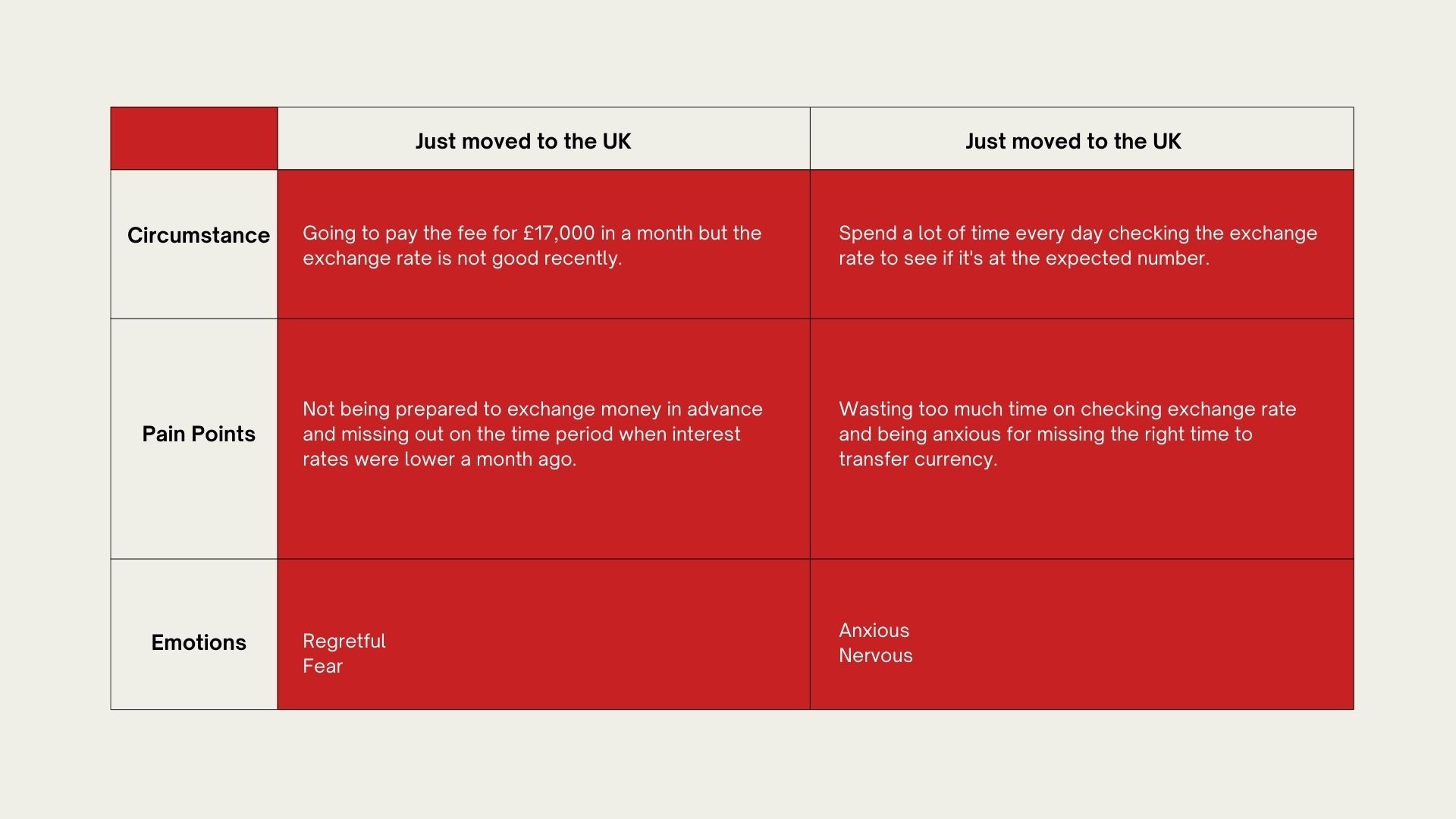
Recently arrived. Regret and fear, driven by mistimed transfers.

Settled longer. Anxiety and exposure, driven by unpredictable outgoings.
|
Imagine if you had…
A six month rent payment due in a week. Assignments due in two days. Utility bills in five. A friend's birthday in six.
And you're reliant on the FX rate that is moving throughout.
The working definition of compounded high emotion we took into design:
We named this "as-is" state: "compounded high emotion",
as it is not a single acute crisis but several ordinary pressures stacking inside one window, with a large uncontrollable financial decision sitting on top of them.
It matters because it changes what the user is optimising for. Several participants described wanting the decision to be over more than wanting it to be right.
That is the condition in which a poorly designed AI intervention does the most damage, and in which a well designed one carries the most value.


Value exchange map. The user holds a fixed sum in their home currency and needs the largest possible variable amount in the new one. The exchange rate sits between the two as an uncontrollable variable, and the pain points recorded in interviews route back through it.
Why this segment
The narrowing was deliberate. Women make up 49.6 per cent of the global population and around 30 per cent are assessed as financially literate (UN DESA; GFLEC). The gap follows from historical exclusion from financial decision making rather than from aptitude, and financial products have been designed around a male default user for long enough that the deficit is structural. The 25 to 39 band concentrates the effect, with high financial pressure, high emotional intensity and limited available time occurring together.
Concluding that designing at the sharp end of a literacy and trust gap tends to produce principles that also hold for less constrained users. Working the other way round is less reliable.

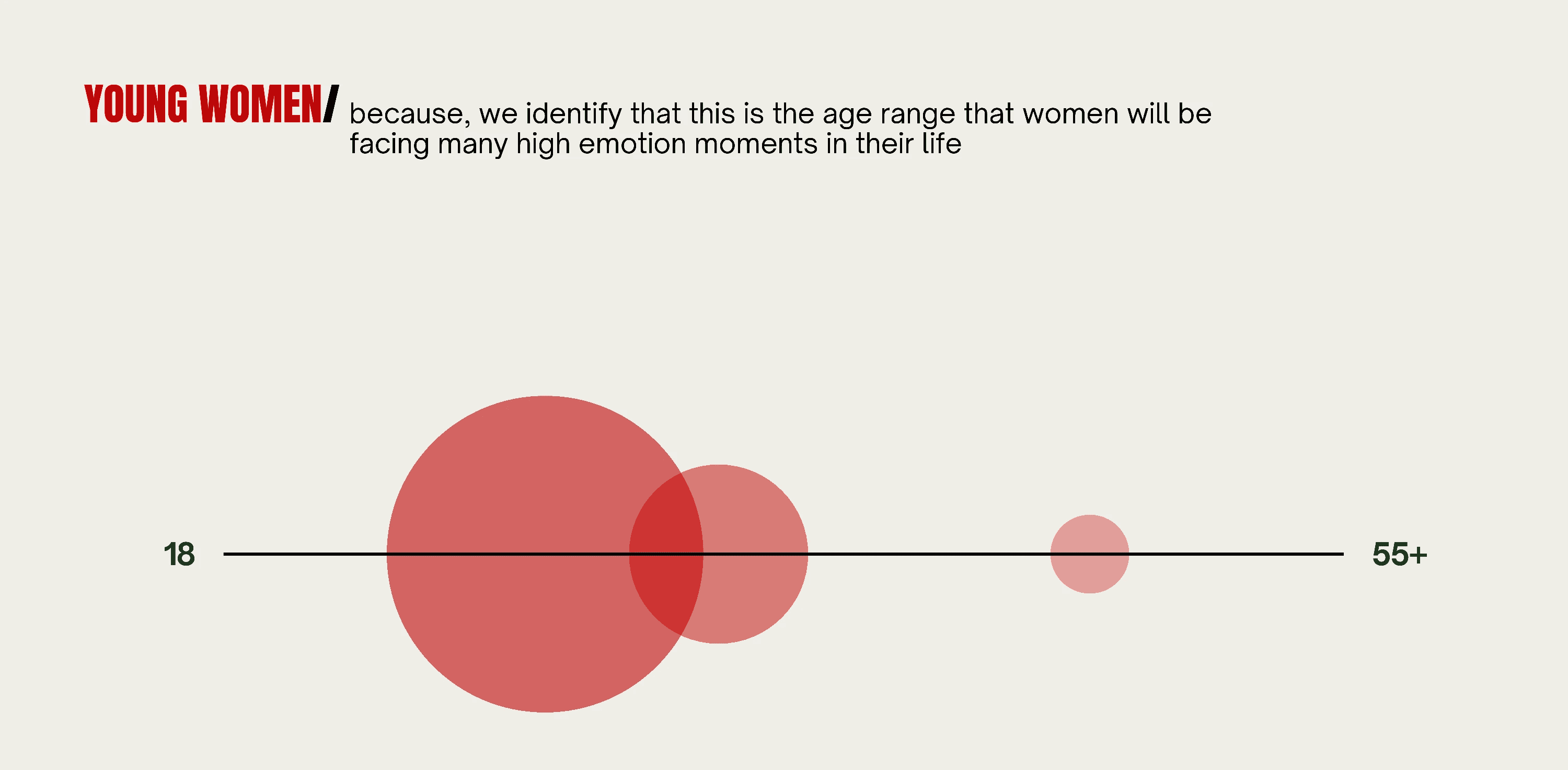
Segment rationale, showing the overlap of financial pressure and emotional intensity.
Hover to reveal
Defining the Problem
Hover to reveal
HMW Statement
Smart Xchange
Overview
A four-month thought leadership engagement into how people decide whether to let an AI service act on their behalf during financial moments they cannot control. The work produced a three-part principle model for designing trust into AI-enabled financial services, and a service concept built to test it.
Categories
Service Design
AI in Financial Services
Thought Leadership
Date
Nov 2024 - Feb 2025
Client
EY Seren (EY Studio+)
Royal College of Art
Role
Service designer. Research synthesis, systems mapping, narrative and delivery.
Key signal:
The feature with the most technical sophistication tested worst. Shown real-time AI insight on market rates, participants said they would verify the figure with their bank or with Google before acting on it.
The features they accepted were the ones where they had set the parameters themselves. On this evidence, participants assessed the AI service on whether anyone could be held responsible for it, before they assessed how well it performed.
Key signal:
The feature with the most technical sophistication tested worst. Shown real-time AI insight on market rates, participants said they would verify the figure with their bank or with Google before acting on it. The features they accepted were the ones where they had set the parameters themselves. On this evidence, participants assessed the AI service on whether anyone could be held responsible for it, before they assessed how well it performed.
Methods:
20 depth interviews with women aged 25 to 39 who had relocated to the UK.
Root cause analysis, use case and journey mapping, emotion mapping, value exchange system mapping, hypothesis-led prototyping, a mixed-gender co-design and testing workshop, and Jobs to Be Done.
Validation:
Three hypotheses were built into discrete feature prototypes and tested in one co-design workshop. One was supported strongly, one partially, one was not supported.
The unsupported result is what shaped the model.
20
women interviewed, aged 25 to 39, relocating or recently relocated to the UK
3
hypotheses built into testable feature prototypes
1 of 3
not supported in testing, including the most technically advanced feature
3
conditions for trust in AI services, argued to hold beyond financial services
Read details below
Findings
A three-part model for trust in AI services
EY Seren set an open brief. In regulated sectors where trust and empathy carry commercial and reputational weight, how can AI provide human-centred support while retaining efficiency? We answered with a model, then built a service concept to test whether it held.
Across interviews and testing, trust did not present as a single property that a service either has or lacks. It presented as three conditions that depend on each other, and the order mattered. Participants responded to the warmth of the language only once they could see who was responsible for the service and what they still controlled themselves. Where those two conditions were missing, the same warm language was read as a sales technique.
Hover to reveal
The building blocks for trust
3 things services need to ensure they can attest to before launching another* AI app that "changes your life"
[Drag to view]
1. Accountability
2. User Agency
3. Empathetic language
Trust is extended in instalments
The model describes the structure. It does not describe the pace. Testing suggested that participants extended trust in small amounts and withdrew it easily, and that each condition had to be visible before the next one registered with them. For a service team this becomes a sequencing decision. Begin with the smallest reversible action, then widen the scope of delegated authority over time, rather than requesting that authority at onboarding.
The sequencing view presented to EY Seren. Human in the loop sits between control and tone.
Visible access to a person is what allowed an automated action to feel reversible to participants.
Why the model may travel. It was derived in currency exchange. The conditions that produced it are a high value decision, an outcome the user cannot influence, low domain literacy, and time pressure.
Those same conditions describe a claims assessment, a benefits application, a diagnosis, and a redundancy consultation. This transfer is argued here rather than tested, and the limits section sets out what that means in practice.
The moment
Compounded high emotion
Studying trust in AI requires a moment where trust is genuinely at stake. General financial anxiety is too diffuse to design against, so the first task was to locate a specific point where emotion, money and powerlessness meet.
We interviewed 20 women aged 25 to 39 who had recently moved to the UK, and used 5 Whys to work past the first answers. Budgeting and adapting to a new cultural context came up in almost every conversation. Both are symptoms rather than design problems.
Underneath them sat something more specific. Money is the mechanism through which the social, functional and emotional needs of a relocation get met. The exchange rate is the one variable in that system the user has no influence over. It is the point at which a person's plan for their new life meets a number they cannot negotiate with.
2 personas, 2 Journeys, 1 Pattern
Recently arrived. Regret and fear, driven by mistimed transfers.
Settled longer. Anxiety and exposure, driven by unpredictable outgoings.
|
Imagine if you had…
A six month rent payment due in a week. Assignments due in two days. Utility bills in five. A friend's birthday in six. And you're reliant on the FX rate that is moving throughout.
The working definition of compounded high emotion we took into design:
We named this "as-is" state: "compounded high emotion",
as it is not a single acute crisis but several ordinary pressures stacking inside one window, with a large uncontrollable financial decision sitting on top of them.
It matters because it changes what the user is optimising for. Several participants described wanting the decision to be over more than wanting it to be right.
That is the condition in which a poorly designed AI intervention does the most damage, and in which a well designed one carries the most value.
Value exchange map (Above).
The user holds a fixed sum in their home currency and needs the largest possible variable amount in the new one. The exchange rate sits between the two as an uncontrollable variable, and the pain points recorded in interviews route back through it.
Why this segment
The narrowing was deliberate. Women make up 49.6 per cent of the global population and around 30 per cent are assessed as financially literate (UN DESA; GFLEC). The gap follows from historical exclusion from financial decision making rather than from aptitude, and financial products have been designed around a male default user for long enough that the deficit is structural. The 25 to 39 band concentrates the effect, with high financial pressure, high emotional intensity and limited available time occurring together.
Concluding that designing at the sharp end of a literacy and trust gap tends to produce principles that also hold for less constrained users. Working the other way round is less reliable.
Value exchange map (Above).
The user holds a fixed sum in their home currency and needs the largest possible variable amount in the new one. The exchange rate sits between the two as an uncontrollable variable, and the pain points recorded in interviews route back through it.
Hover to reveal
Defining the Problem
Hover to reveal
HMW Statement
Smart Xchange
Overview
A four-month thought leadership engagement into how people decide whether to let an AI service act on their behalf during financial moments they cannot control. The work produced a three-part principle model for designing trust into AI-enabled financial services, and a service concept built to test it.
Categories
Service Design
AI in Financial Services
Thought Leadership
Date
Nov 2024 - Feb 2025
Client
EY Seren (EY Studio+)
Royal College of Art
Role
Service designer. Research synthesis, systems mapping, narrative and delivery.
Key signal:
The feature with the most technical sophistication tested worst. Shown real-time AI insight on market rates, participants said they would verify the figure with their bank or with Google before acting on it.
The features they accepted were the ones where they had set the parameters themselves. On this evidence, participants assessed the AI service on whether anyone could be held responsible for it, before they assessed how well it performed.
Methods:
20 depth interviews with women aged 25 to 39 who had relocated to the UK.
Root cause analysis, use case and journey mapping, emotion mapping, value exchange system mapping, hypothesis-led prototyping, a mixed-gender co-design and testing workshop, and Jobs to Be Done.
Validation:
Three hypotheses were built into discrete feature prototypes and tested in one co-design workshop. One was supported strongly, one partially, one was not supported.
The unsupported result is what shaped the model.
20
women interviewed, aged 25 to 39, relocating or recently relocated to the UK
3
hypotheses built into testable feature prototypes
1 of 3
not supported in testing, including the most technically advanced feature
3
conditions for trust in AI services, argued to hold beyond financial services
Read details below
Findings
A three-part model for trust in AI services
EY Seren set an open brief. In regulated sectors where trust and empathy carry commercial and reputational weight, how can AI provide human-centred support while retaining efficiency? We answered with a model, then built a service concept to test whether it held.
Across interviews and testing, trust did not present as a single property that a service either has or lacks. It presented as three conditions that depend on each other, and the order mattered. Participants responded to the warmth of the language only once they could see who was responsible for the service and what they still controlled themselves. Where those two conditions were missing, the same warm language was read as a sales technique.
Hover to reveal
The building blocks for trust
3 things services need to ensure they can attest to before launching another* AI app that "changes your life"
[Drag to view]
1. Accountability
2. User Agency
3. Empathetic language
Trust is extended in instalments
The model describes the structure. It does not describe the pace. Testing suggested that participants extended trust in small amounts and withdrew it easily, and that each condition had to be visible before the next one registered with them. For a service team this becomes a sequencing decision. Begin with the smallest reversible action, then widen the scope of delegated authority over time, rather than requesting that authority at onboarding.
The sequencing view presented to EY Seren. Human in the loop sits between control and tone.
Visible access to a person is what allowed an automated action to feel reversible to participants.
Why the model may travel. It was derived in currency exchange. The conditions that produced it are a high value decision, an outcome the user cannot influence, low domain literacy, and time pressure.
Those same conditions describe a claims assessment, a benefits application, a diagnosis, and a redundancy consultation. This transfer is argued here rather than tested, and the limits section sets out what that means in practice.
The moment
Compounded high emotion
Studying trust in AI requires a moment where trust is genuinely at stake. General financial anxiety is too diffuse to design against, so the first task was to locate a specific point where emotion, money and powerlessness meet.
We interviewed 20 women aged 25 to 39 who had recently moved to the UK, and used 5 Whys to work past the first answers. Budgeting and adapting to a new cultural context came up in almost every conversation. Both are symptoms rather than design problems.
Underneath them sat something more specific. Money is the mechanism through which the social, functional and emotional needs of a relocation get met. The exchange rate is the one variable in that system the user has no influence over. It is the point at which a person's plan for their new life meets a number they cannot negotiate with.
2 personas, 2 Journeys, 1 Pattern
Recently arrived. Regret and fear, driven by mistimed transfers.
Settled longer. Anxiety and exposure, driven by unpredictable outgoings.
|
Imagine if you had…
A six month rent payment due in a week. Assignments due in two days. Utility bills in five. A friend's birthday in six.
And you're reliant on the FX rate that is moving throughout.
The working definition of compounded high emotion we took into design:
We named this "as-is" state: "compounded high emotion",
as it is not a single acute crisis but several ordinary pressures stacking inside one window, with a large uncontrollable financial decision sitting on top of them.
It matters because it changes what the user is optimising for. Several participants described wanting the decision to be over more than wanting it to be right.
That is the condition in which a poorly designed AI intervention does the most damage, and in which a well designed one carries the most value.
Value exchange map. The user holds a fixed sum in their home currency and needs the largest possible variable amount in the new one. The exchange rate sits between the two as an uncontrollable variable, and the pain points recorded in interviews route back through it.
Why this segment
The narrowing was deliberate. Women make up 49.6 per cent of the global population and around 30 per cent are assessed as financially literate (UN DESA; GFLEC). The gap follows from historical exclusion from financial decision making rather than from aptitude, and financial products have been designed around a male default user for long enough that the deficit is structural. The 25 to 39 band concentrates the effect, with high financial pressure, high emotional intensity and limited available time occurring together.
Concluding that designing at the sharp end of a literacy and trust gap tends to produce principles that also hold for less constrained users. Working the other way round is less reliable.
Segment rationale, showing the overlap of financial pressure and emotional intensity.
Hover to reveal
Defining the Problem
Hover to reveal